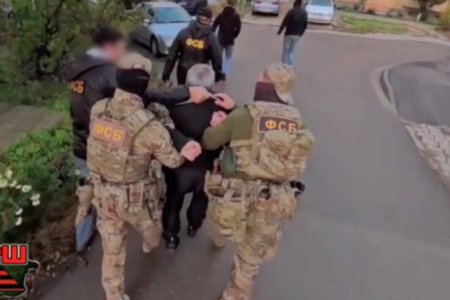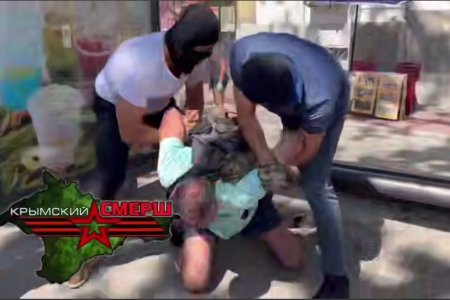
Russia’s Southern District Military Court has sentenced Serhiy Tubolets from occupied Sevastopol to five and a half years’ imprisonment for comments on social media. The comments, even if strong, could not have been worse than countless calls by Russian leaders and propagandists to bomb Ukrainian cities and even attempts to justify Russia’s bombing of Ukraine’s main children’s hospital Okhmatdyt on 8 July 2024. Yet it was the Ukrainian from occupied Sevastopol who was charged with ‘publicly justifying terrorism’, not those who justified deadly missile strikes against children.
Serhiy Tubolets (b. 14.08.1976) was charged over six social media posts in September 2024, February and May 2025, which purportedly contained “calls to destructive actions in the form of strikes and shelling of the territory of the Russian Federation”, under Article 205.2 § 2 of Russia’s criminal code. Under the same article, he was further accused of having posted three texts in March 2025 “containing a collection of linguistic and psychological indicators of justification of terrorist actions.”
It is, in fact, likely that Tubolets expressed support for strikes on legitimate military targets on occupied territory or in Russia, with this in no way linked with ‘terrorism’. That cannot be verified, but only because the content of the social media posts for which he was detained was not made public and even the announcement of the sentence was effectively concealed. Crimean Process reported that eight hours after the Southern District Military Court’s press service had posted details of the sentence passed by ‘judge’ Arslan Ivanovich Zhaginov on 30 March, there was still no information of the court’s site, meaning that the public were denied any possibility of being present at the hearing or at least knowing in advance when it was due.
The main problem, however, remains the lack of any information about the posts themselves with Russia having consistently abused terrorism changes in multiple trials of Ukrainian prisoners of war and political prisoners. The same Southern District Military Court has sentenced a huge number of Ukrainian servicemen taken prisoner while defending Ukraine to 20-30 years, or even life imprisonment, on the basis of flawed and politically motivated Russian court rulings which claimed that regiments or battalions of Ukraine’s Armed Forces are ‘terrorist organizations’.
Having thus violated international law by prosecuting Ukrainians for defending their country, Russia then used the same charge as against Tubolets to sentence Sergei Davidis, Head of the Memorial Support for Political Prisoners Project, to six years’ imprisonment. His supposed ‘crime’ was that he rightly referred to such imprisoned Ukrainian prisoners of war as political prisoners. The Russian prosecutor claimed that this also constituted ‘justification of terrorism’ under Article 205.2 § 2 of Russia’s criminal code. On 17 February 2026, Natalia Pukash, a 52-year-old resident of Kalanchak in occupied Kherson oblast, was sentenced to six years’ imprisonment for two videos and accompanying comments on social media. She too was charged with ‘justifying terrorism’, under Article 205.2 § 2, as well as with ‘calls to actions aimed against the security of the Russian state’ (Article 280.4 § 2c). She was alleged to have ‘justified terrorism’ through a comment under a video about the death of Vladlen Tatarsky, a notorious pro-war propagandist and military blogger who was killed in a targeted attack in St Petersburg on 2 April 2023. Russia, which regularly bombs Ukrainian residential buildings, hospitals and playgrounds, claimed that this was ‘a terrorist attack’.
There seems every reason to assume that Serhiy Tubolets is just as much a victim of Russia’s highly selective and illegal weaponization of criminal charges against Ukrainians on occupied territory. Indeed, the Memorial Support for Political Prisoners Project has placed Tubolets on its list of other victims of political persecution. This is applied where there is insufficient information to formally recognize a person as a political prisoner, but where there are strong grounds for assuming that the charges are politically motivated.
Incitement to genocide
Although Russia’s defence ministry continues to repeat, against all evidence, the claim that Russia never attacks civilians, Russian propagandists, including those closest to the Kremlin, like Vladimir Solovyov, quite openly gloat over or call for attacks on Ukrainian cities. Virtually any call to violence will be accepted as long as the targets are Ukrainian.
International lawyers, human rights defenders and others published a study back in May 2022, detailing the grounds for concern about likely genocide by Russia in Ukraine. These included the constant denial by Russia’s leaders and the media of the very existence of a Ukrainian identity; their use of dehumanizing language and propaganda to justify atrocities beyond the battlefield. They wrote that “the Ukrainian civilian population and elites are being described to Russians as their mortal enemies, some of whom must be liquidated.” The authors pointed out that such evidence “triggers the legal obligation of all States to prevent genocide.”
In September 2023, the UN Independent International Commission of Inquiry on Ukraine reported evidence that the Russian military were committing grave war crimes and possible crimes against humanity in Ukraine. The Commission expressed concern about allegations of genocide and stated that “some of the rhetoric transmitted in Russian state and other media may constitute incitement to genocide”.