In May 2025, Freedom House published its first combined assessment of the situation in all Russian-occupied parts of Ukraine and it was blistering. The rating was not only massively lower than in free Ukraine, but significantly lower than in Russia itself and countries like North Korea and Turkmenistan. By the end of 2025, it was clear that Russian repression and lawlessness had descended still further. The following, which is by no means an exhaustive account, is primarily about occupied Crimea, since more information is available. There are no grounds for believing the situation to be any better on other occupied territory.
Mounting terror: enforced disappearances and a huge escalation in the persecution of women and of entire families
In 2025, for the first time, Russia arrested women for its conveyor-belt repression against Crimean Muslims. Esma Nimetulayeva (b. 1985), the wife of a Crimean Tatar political prisoner and mother of five, as well as three very young Crimean Tatar women - Elviza Alieva (b. 2005); Fevziye Osmanova (b. 2004); and Nasiba Saidova (b. 2006) are now in detention, and facing huge sentences on totally fabricated ‘terrorism charges’ (see: Four Crimean Tatar women could face 20-year sentences in new wave of Russian terror in occupied Crimea).
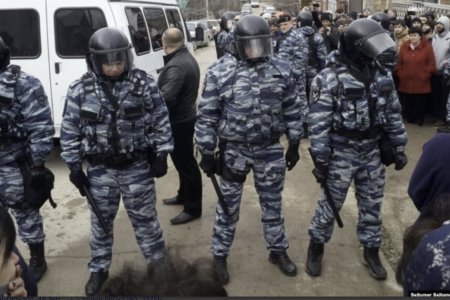
There has, in general, been a huge increase in the number of women seized by the Russian FSB on all occupied territory. The majority of such cases have more in common with enforced disappearances, than arrests, with it often months, or over a year, before human rights groups even learn of a person’s disappearance and / or discover where the person is being held. Often, it is only when sentences are announced, that there is any formal confirmation that the person is in custody. This was true of the 15-year sentences against 28-year-old Lera Dzhemilova and 38-year-old mother of two Niyara Ersmambetova, and the 16-year sentence against 66-year-old Nina Tymoshenko. In all cases, the women’s ‘trials’, should there have been more than the hearing to announce the sentences, were hold before occupation ‘courts’ behind closed doors. Where the only remaining parent or both have been abducted, no consideration is taken of the fact that children have been effectively orphaned while having loving parents who want to look after them. More about such victims here: Russian FSB escalate abductions and terror against women in occupied Crimea.
There has also been a sharp escalation in Russia’s persecution of whole families. Such persecution is not new, with Russia’s FSB having come for all of the sons of Crimean Tatar historian Seitumerov, as well as the sons’ maternal grandmother. Among Russia’s Crimean political prisoners are also Enver Omerov (b. 1961) and his son, Riza Omerov (b. 1988); Teymur Abdullayev (b. 1975) and Uzeir Abdullayev (b. 1974) and many others. There have been more cases, however, including the abduction in March 2025 of Tetiana Maliar (b. 1968); Tetiana’s brother Valentyn Maliar (b. 1974); her son Anatoliy Rossikhin (b. 1986) and her daughter Olha Behei (b. 1992). Olha was taken away, despite having two underage children: Alisa, who is 11 and 7-year-old Ruslan. After seizing Natalia Poliukh (b. 1975) and her husband Oleh Platonov (b. 1963), the occupation ‘authorities’ reportedly placed their 9-year daughter in care. On 5 August 2025, 42-year-old Victoria Strilets and her 25-year-old daughter Oleksandra Strilets were sentenced to 12 years on surreal ‘treason’ charges. Oleksandra was accused essentially over photos posted on Messenger. She has two very small children, Solomiia, who is four years old, and a six-month-old daughter Lera, who was born very small and was, at least in August 2025, still in an incubator, unable to breathe by herself.
The whereabouts are also unknown, or not officially admitted, of a number of men who disappeared after being seized by the Russian occupation ‘enforcement bodies’. They include 58-year-old Serhiy Hryshchenkov and Anatoliy Kobzar, both of whom were likely targeted because of their clear pro-Ukrainian position.
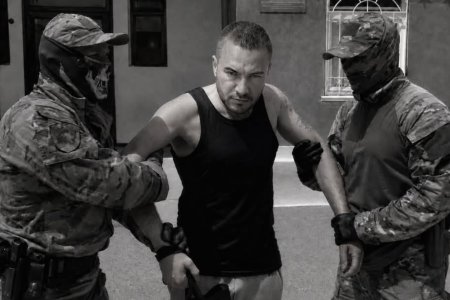
In one chilling case, 65-year-old Seitkhalil Fakhriyev and his 36-year-old son, Ruslan Fakhriyev were seized by Russian enforcement officers who burst into their home during the night from 15-16 November 2025. On 30 November, the FSB claimed that they had killed a man who supposedly refused to surrender when caught planting a bomb in the car of a high-ranking official. The FSB claimed that this alleged ‘act of terrorism’ had been planned by Rustem Fakhriyev, Seitkhalil Fakhriyev’s elder son, who is an officer in Ukraine’s Military Intelligence. It was unofficially reported that it was his relative who had been killed. While it remains unclear who was killed, there is concern, as this would not be the first time that the FSB have fabricated justification for killing a detainee already in custody.
In all areas under Russian occupation, 2025 saw a sharp increase in the number of cases of Ukrainians sentenced to 12 years or more for donations to Ukraine’s Armed Forces, with the invading state usually claiming this to have been ‘treason’ (details here).
Repression for telling the truth or for openly identifying with Ukraine
Overt persecution of Crimean Tatars and other Ukrainians for expressing opposition to Russia’s war against Ukraine or even merely for playing Ukrainian songs, or its national anthem first escalated in 2022, and is ongoing.
Some of the sentences, however, are considerably harsher than before, with criminal charges (rather than administrative) laid and people receiving real sentences.
Serhiy Laponohov
On 19 December 2025, an occupation ‘court’ sentenced 52-year-old Serhiy Laponohov to three years’ imprisonment for three comments in 2023 and 2024 on social media. These were claimed to constitute ‘calls to extremism’ and to incite to “violent actions with respect to persons according to their nationality”. It is clear that the comments were unflattering, if not more, about Russians, but this was almost certainly in the context of Russia’s full-scale invasion of Ukraine. It is also true, as Crimean Tribunal points out, that there have been no cases of criminal prosecution in defence of people of any other nationality in occupied Crimea. In fact, if you listen to Russian talk shows on state-controlled television channels, speakers constantly call for horrific acts of violence against all Ukrainians.
Yevhen Shved
32-year-old Yevhen Shved from Dzhankoi was sentenced in December 2025 to four years’ medium-security imprisonment over posting two videos and a photograph on the day of the attack on Russia’s illegal Crimean Bridge on 8 October 2022. Russia insists on calling this attack on a perfectly legitimate military target, used to transport military personnel, hardware and weapons, a ‘terrorist act’. It was claimed that the comments under these social media posts “contained the linguistic indicators of justification for this act of terrorism’.
As reported, on 27 February 2024, Shved was sentenced by the Russian occupation ‘Crimean high court’ to two and a half years’ imprisonment for a post on his Telegram channel in which he criticized the hypocrisy and falseness around Russia’s marking of Victory Day on 9 May. The 31-year-old Ukrainian from Dzhankoi was prosecuted under a norm on supposed ‘rehabilitation of Nazism’, one of many articles of Russia’s criminal code used by the current Russian regime, occupying Crimea, to persecute people for expressing their views. The ‘judge’ in this case, Natalia Kulinskaya, had previously gained notoriety for her part in the politically motivated imprisonment of Ukrainian civic journalist and activist Iryna Danilovich and was recently involved in sentencing Ismail Shemshedinov, a young Crimean Tatar father to 13 years maximum-security imprisonment on ‘treason’ charges probably over “anti-Russian commentaries”.
In November 2025, 38-year-old Kateryna Fomenko was sentenced to five and a half years’ imprisonment in the first case involving so-called ‘military fakes’ on occupied territory. Article 207.3 § 2 of Russia’s criminal code was the most draconian of four new charges rushed into law ten days after Russia’s full-scale invasion of Ukraine. Although there was secrecy over what the post from June 2024 contained, the charge has, up till now, been used to imprison people for writing the truth about Russian atrocities in Bucha, Mariupol and other Ukrainian cities
Russia is also using armed raids and interrogations of journalists, as well as surreal prosecutions (for quoting a UN report, for example) and crippling fines to try to silence journalists or force them out of occupied Crimea.
It has also escalated its persecution of renowned journalist and human rights defender Lutfiye Zudiyeva (see: Menacing threats against human rights defender Lutfiye Zudiyeva after Russia’s arrests of four Crimean Tatar women).
Although Russia’s use of persecution and harassment against courageous lawyers defending political prisoners began several years ago, it took on a new and sinister level on 11 December. The warrant for the so-called ‘inspection’ that day, in which confidential documents about cases were removed, claimed that there were grounds for suspecting lawyers defending recognized political prisoners of fictitious ‘terrorism’ (see: Chillingly lawless armed raid on Crimean Tatar lawyers defending victims of Russian repression).
There are mounting efforts to impose a near total information blockade on occupied territory.
It became clear in August 2025 that Russia was blocking calls on both WhatsApp and Telegram, with this depriving Ukrainians on occupied territory of effectively the only way of maintaining contact with relatives and friends in government-controlled Ukraine and of receiving uncensored information.
This coincided with Russia’s foisting of its own messenger app called MAX. The app has been described as “a spy in your pocket”, making it possible to follow a person’s movements and behaviour in real time. Photos, audio material; the person’s coordinates, activities, etc. can be immediately sent on to Russian servers and, more than likely, Russia’s FSB. Russia is now using coercion to force people to “voluntarily hand over their telephone into the total control of the security service”, and failure to do so already exposes a person to even greater levels of harassment and scrutiny.