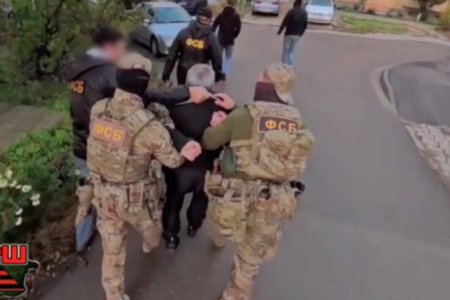
Russia’s Second Western District Military Court has sentenced Volodymyr Dobriyan (b. 24.03.1989) to five years’ imprisonment because of two posts on Telegram from June and August 2025. This is one of an ever-increasing number of real 5 and 6-year sentences against Ukrainians for expressing support for Ukraine or opposition to Russia’s war of aggression. It does, however, stand out for the cynicism of the charges against the 37-year-old Ukrainian, originally from Donetsk oblast, but presumably seized in Russia.
The posts purportedly expressed support for Ukrainian drone strikes on an oil refinery in Samara oblast and Nikolskoye, a village in Belgorod oblast. The aggressor state which bombs residential buildings, playgrounds and hospitals almost daily and whose drone attacks on civilians have been condemned as crimes against humanity by UN monitors claimed that this constituted ‘public justification of terrorism’. Dobriyan had allegedly “acted with the aim of justifying terrorism” and in opposition to Russian leader Vladimir Putin’s so-called ‘special military operation’, i.e. its full-scale invasion of Ukraine. Although Russian propagandists openly boast of attacks on civilians, the Kremlin and Russian defence ministry continue to deny them all. This denial is then used as excuse for calling truthful comments about Bucha, Mariupol and Russian war crime ‘knowingly false information’ and to sentence Russians and Ukrainians to long terms of imprisonment. The coast is therefore clear for Russia to claim that Ukraine’s drones are ‘terrorist attacks’, and to assert that approval of Ukraine’s self-defence against an invader is ‘justification of terrorist activities’, under Article 205.2.§ 2 of Russia’s criminal code.
The other parts of the indictment are no less cynical. Dobriyan was also ‘accused’ of having stated that occupied parts of the Donetsk; Luhansk; Kherson and Zaporizhzhia oblasts are Ukrainian territory which should be liberated from Russian occupation. At the beginning of 2025, he supposedly joined pro-Ukrainian groups opposed to the Russian regime and expressed his negative attitude “to Russian people; to Russian soldiers, insulted them, discredited the Russian government and army and justified the actions of Ukraine’s armed formations”. This extraordinary verbiage is how Russian prosecutors and ‘judges’ try to blur the inconvenient fact that they are prosecuting a Ukrainian citizen for supporting the Armed Forces who are defending Ukraine against an armed invader.
Dobriyan was sentenced to five years’ medium-security imprisonment and banned from administering sites or electronic or telecommunications channels for three years. Dobriyan did not deny posting the social media texts and said that he had been in a depressed state. He can still, and hopefully will, lodge an appeal, although this is a politically motivated prosecution as would be the hearing before a Russian court of appeal.
Russia is increasingly using this supposed ‘public justification of terrorism’ charge and passing real sentences. In the first years after its invasion and annexation of Crimea, those Ukrainians or Russians who called for de-occupation of Crimea and stated that Crimea was part of Ukraine found themselves on ‘trial’ for supposedly making ‘public calls to action aimed at violating Russia’s territorial integrity’ [sic], under Article 280.1 of Russia’s criminal code. The sentences were significantly lower, however. and might even be suspended. Now Russia uses ‘terrorism’ legislation or similar charges, with real sentences near certain.
In occupied Sevastopol, a 23-year-old student is facing a 5-year sentence on charges of ‘public calls to extremist activities’. He is claimed to have made ‘calls to violence against compatriots’, with the aggressor state almost certainly referring to comments opposing the Russian invaders. The young man had earlier, in February 2026, received a 50 thousand rouble fine for supposed ‘discrediting Russia’s armed forces’.
Essentially identical charges are now facing a 63-year-old from occupied Berdiansk (Zaporizhzhia oblast), with he also seized and held in captivity.