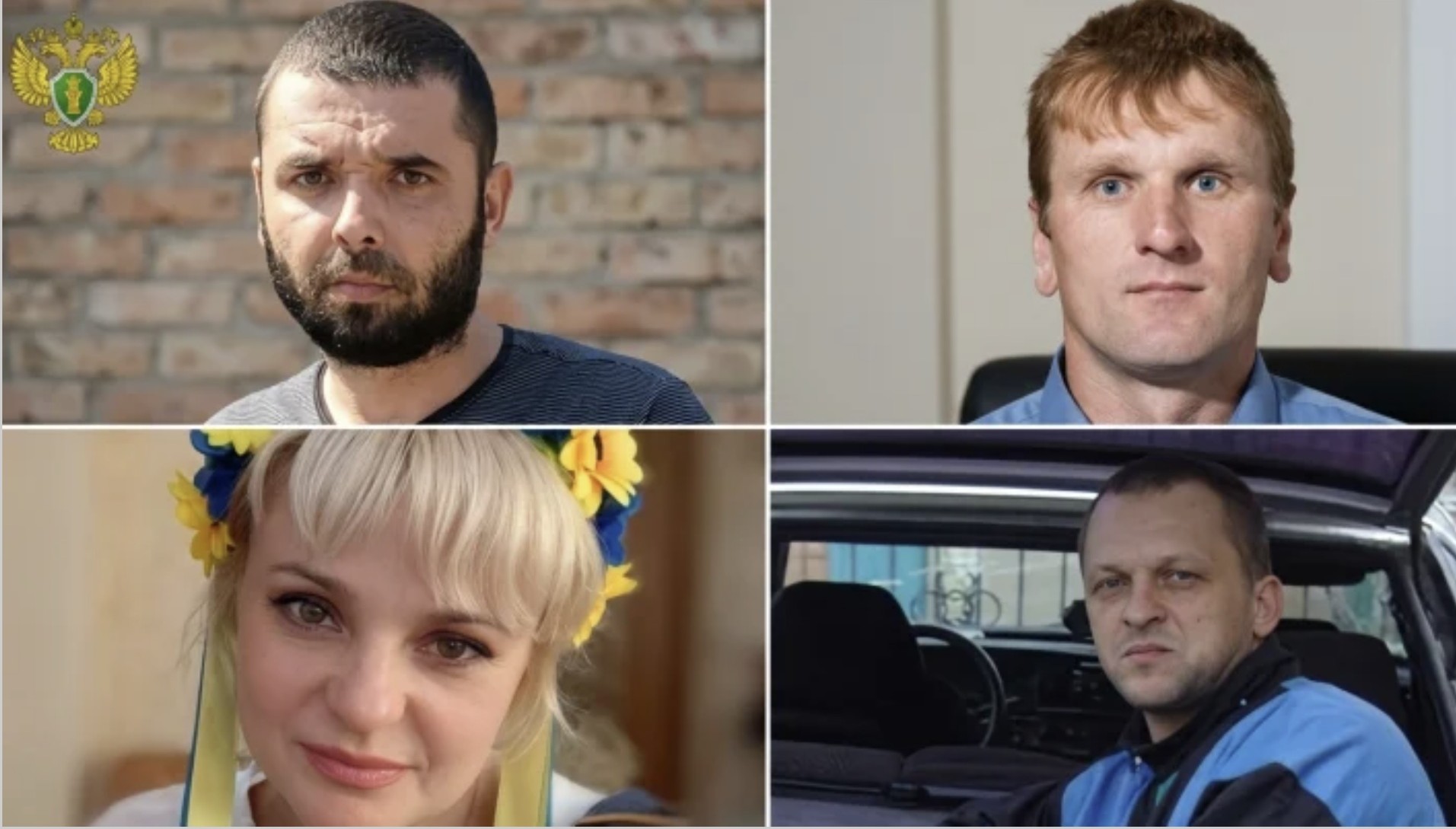
While ’guilty’ verdicts and long sentences were guaranteed when Russian began its ‘trial’ of four Ukrainians abducted from occupied Melitopol, the four are making sure that each player in the brutal and lawless travesty is named. This unfortunately includes two Melitopol lawyers who have proven willing to help the Russian invaders persecute their compatriots.
Neither Serhiy Harkusha’s earlier account of the torture to which he was subjected, nor the details which emerged during the hearing on 4 June 2026 can be called surprising. Russia has, however, placed such clamps on information about its persecution of Ukrainians from occupied territory that any confirmation of the methods used to churn out huge sentences on ‘terrorism’ charges deserves attention.
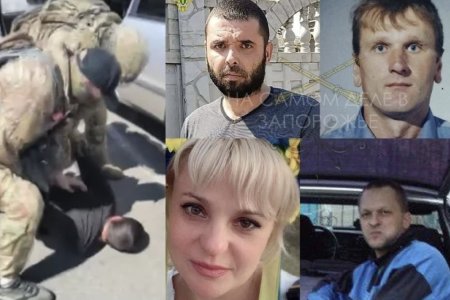
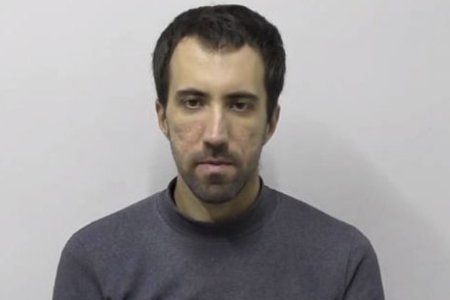
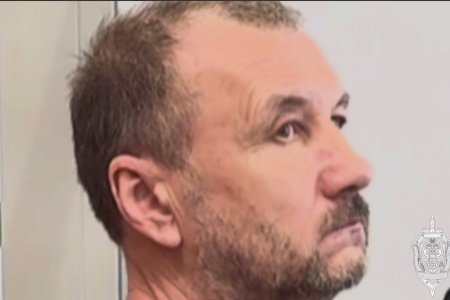
Russia is claiming that a partisan attack on 27 April 2023 which killed Oleksandr Mishchenko, a Ukrainian collaborator appointed by the Russian invaders as ‘deputy head of the Melitopol police’, as well as the attack on Dmytro Trukhin, another traitor, serving in the occupation administration, constituted ‘acts of terrorism’. A ‘trial’ is now underway at Russia’s notorious Southern District Military Court of four Melitopol residents who were abducted on or after 27 April 2026. Serhiy Harkusha; Ihor Haranin; Olena Roi and Serhiy Yevtushenko are facing a barrage of ‘terrorism’ and weapons / explosives charges which could carry life sentence, Mishchenko was a legitimate target whose death had nothing to do with terrorism. It is also likely that in some, if not all, cases, the only ‘evidence’ of involvement is from ‘confessions’ which all say were extracted through torture.
Mediazona reports that on 4 June, the questioning took place of the ‘investigator’ and prosecution-appointed ‘lawyers’ whom all four defendants accuse of involvement in the fabrication of their supposed ‘testimony’. All of them are adamant that they signed the so-called ‘confessions’ in 2023 under torture, without a defence lawyer being present and without their formal detention. Instead of representing them, the lawyers appointed for them had, effectively, collaborated with the prosecution.
The first to be question was Serhiy Kostyshak who is supposed to have represented Serhiy Yevtushenko during the pre-trial investigation. He claimed to have heard nothing about any violence and threats against Yevtushenko, and asserted that, had there been such cases, he would have reacted. He went on to deny that Yevtushenko had complained to him about his state of health.
Kostyshak was, however, ‘unable’ to answer the perfectly simple question whether or not had been present at Yevtushenko’s purported identification by Haranin. He first tried to claim that he couldn’t answer because of lawyer’s confidentiality and that said that he “needed to read the protocol in order to remember”. Both Yevtushenko and Haranin assert that Kostyshak was not present although his signature is on the document.
Both Kostyshak and Oleksandr Tsokalo, who was supposed to be representing Harkusha, worked as lawyers in Melitopol before Russia’s invasion. During his questioning, Tsokalo claimed that he had been present at all so-called investigative activities involving Harkusha, including at interrogations “from the beginning to the end”. He also asserted that Harkusha had looked absolutely normal, was calm, and did not complain of torture.
Harkusha earlier told the court that he had been beaten for 4-5 days by FSB men in balaclavas, after which he had signed the ‘confession’ thrust in front of him, without reading it. Harkusha says that Tsokalo appeared around 40 minutes later, flicked through the supposed ‘confession’ and put his signature on it. He said that he “can’t help in any way”, and after talking with Harkusha for around three minutes, he turned around and left.
‘Investigator’ Denis Gubin then took the stand. He claimed that he had interrogated Harkusha in the presence of “lawyer Tsokalo” and that he had made a record of the interrogation based on Harkusha’s words, with nothing made up. Gubin went on to deny that any of the defendants had complained of torture.
It may, in fact, have been true that there were “no complaints of torture”, but that was surely because complaining to those directly involved in torture would very likely result in still further torture. It is, however, impossible that the evidence of such beatings and other forms of torture were not visible.
Olena Roi stated that Gubin had invented her supposed testimony about alleged acquaintance with Yevtushenko. He had turned up at the temporary holding unit where she was being held and handed her this so-called protocol of her testimony for her signature, without actually carrying out a formal interrogation. Harkusha said the same. Yevtushenko, who is likely to have been feeling extremely unwell, was told by Gubin that he should not retract the supposed ‘confession’ obtained through torture since he would be part of a prisoner exchange and that then it won’t matter what was written there. If he did retract the ;confession’, Gubin threatened, he would once again face the same methods in a basement (used by the invaders as prison torture chambers).
The account given by all four defendants forms one consistent whole, and is depressingly similar to the experiences of numerous Ukrainian political prisoners since Russia first invaded Crimea in 2014. The methods used, in particular, the extraction of fake ‘confessions’ through the use of torture, have been condemned by, among others, the UN Independent International Commission of Inquiry on Ukraine.
Serhiy Harkusha (b. 31.12.1971) was seized by the Russians on 27 April 2023. The prosecution is claiming that he was the leader of the supposed ‘terrorist group’. In court on 21 April this year, Harkusha gave a detailed account of the torture methods used to extract his ‘confession’, but is not, seemingly, denying involvement in Mishchenko’s death.
Ihor Haranin (b. 26.12.1987) was also abducted on the day that Mishchenko was killed and is accused of carrying out the killing. Olena Roi (b. 7.01.1980) is a medic and the widow of Yury Roi, who was killed defending Mariupol on 19 March 2022. It is not clear when she was taken prisoner, but as the wife of a Ukrainian defender, she would be an obvious target when the FSB wanted to claim a ‘terrorist group’. The fact that the Russians call Roi and Harkusha ‘Russians’ seems especially cynical, and is probably based solely on the fact of Russian citizenship, without which Russia is making it near impossible to live on occupied territory. Serhiy Yevtushenko (b. 24.03.1968) suffers from an aggressive form of sugar diabetes and should not be imprisoned even on health grounds. There is also every reason to assume he was seized because the FSB wanted to claim they had ‘found the culprits’ of a traitor’s killing and needed enough so-called members of an absolutely hypothetical ‘terrorist group’. RIA-South is surely right that the FSB’s speed in claiming to have ‘solved’ Mishchenko’s killing by 2 May 2023 may well indicate that they grabbed whoever was at hand and then used torture to fabricate a story.
The indictment against the four was passed to the Southern District Military Court in November 2024. In announcing this, the Russian prosecutor general said that they were accused of “joining a terrorist organization created by Ukraine’s security service in 2022”, carrying out surveillance of Russian-installed officials for their supposed handlers and organizing the two above-mentioned attacks. It is claimed that they were seized in May 2023, although at least Harkusha was abducted on 27 April 2023. The charges are of ‘involvement in a terrorist organization’ under Article 205.4 § 2 of Russia’s criminal code; of a terrorist attack (Article 205 § 2) and of explosives charges under Articles 222.1 § 4 and 223.1 § 4.
The defendants have spoken of torture at least twice. This is, however, a ‘trial’ in which both prosecutor Sergei Aidinov and ‘judge’ Kirill Nikolaevich Krivtsov, have been involved in sentencing a large number of Crimean Tatar and other Ukrainian political prisoners and prisoners of war to huge terms of imprisonment despite evidently fabricated evidence and flawed charges.
See also: Ukrainian political prisoner tells Russian court of torture after which you’ll sign anything