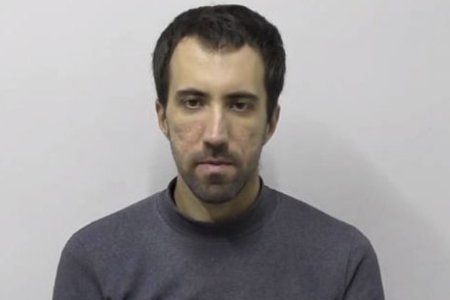
Russia’s Southern District Military Court has passed a massive 24-year sentence against 43-year-old Denys Zhirakov* from occupied Melitopol. While by no means the first time that the occupying state has illegally sentenced Ukrainians to decades in Russian captivity, the prosecution in this case does not even seem to have tried to make the charges plausible. The only recognizable ‘offence’ in the case involves a charge most often added when the FSB claim to have ‘found’ explosives or weapons which they themselves planted.
Virtually nothing is known about Denys Zhirakov (b. 20.08.1982) although RIA-South appears to have found him on social media and says that he has a law degree and had some kind of business. Judging by the court press service’s report, which essentially repeats the indictment, he would seem to have been arrested no earlier than April 2025. Even this should, however, be viewed with caution. In sentencing Kherson IT specialist Iryna Horobtsova to 10.5 years on ‘spying charges’, the Russians claimed that she had been engaged in such ‘spying’ for around 10 months after she had, in fact, been abducted from her home and illegally taken to occupied Crimea.
We know with certainty only that Zhirakov had been added to Russia’s notorious ‘Register of terrorists and extremists’ by March 2026. This was not only before any conviction, but even before the case was passed to the Southern District Military Court in April 2026. There were, at most, two ‘hearings’ before the announcement of the sentence with this suggesting that Zhirakov had not admitted to all or even some of the charges, and clearly far too few for any real assessment of the evidence.
The charges were of ‘treason’ under Article 275 of Russia’s criminal code; of ‘involvement in a terrorist organization’ (Article 205.4 § 2) and of ‘purchase, transportation, possession, etc. of explosive substances or devices’, carried out by an organized group (Article 222.1 § 4).
It had, supposedly, been established that a representative of the Ukrainian Defence Ministry’s Military Intelligence [HUR] contacted Zhirakov “in 2022”, just not precisely when. Then, on 10 August 2022, there was, purportedly, a meeting between this person “from HUR” and Zhirakov “at a carpark in Zaporizhzhia”. During this the man from HUR was alleged to have suggested that Zhirakov “join a terrorist organization which he had created to provide help to Ukraine and that the latter had agreed.
Given the 24-year sentence, it is worth quoting this surreal report in full. (Having agreed to cooperate with the still unidentified man from HUR, and) “in order to carry out his role in the activities of the criminal organization, on 15 August 2022, Zhirakov met with the member of a terrorist organization in the same place and received a mobile telephone in order to organize conspiratorial contact. Later the defendant, carrying out the role assigned to him in the terrorist organization and acting on instructions from the employee of HUR, removed from indicated hiding places explosive substances and devices, as well as other components needed to prepare a homemade explosive device, placed these in the car he used and took them to his place of residence where he held them until 4 April 2025 when these items were removed by employees of the law enforcement bodies.”
The Russian prosecutor has thus claimed, and a Russian court accepted, that a Ukrainian citizen helping his country’s Military Defence provide assistance to his own country under invasion constituted ‘involvement in a terrorist organization’. Russia has made it near impossible to live on occupied territory without a Russian passport, with the aggressor state then using such citizenship as excuse for also accusing him of ‘treason’ against Russia and for holding all proceedings behind closed doors.
Russia’s FSB has been claiming very publicly to have “thwarted” acts of sabotage or terrorism since 2015. There is never any way of proving that there were genuinely plans to commit such sabotage / terrorism, although the lack of evidence is never an impediment to handing down long sentences. Here, however, there are no claims about plans for the supposed explosive substances and devices, just the assertion that Zhirakov collected and held the alleged items in his home, conceivably for years. The maximum sentence envisaged over the purported possession charge is 15 years, with the extra nine presumably because this was claimed to be ‘treason’ and ‘involvement in a terrorist organization’, two of the charges standardly used in political trials of Ukrainians from occupied territory.
A considerable number of former or present political prisoners have received long sentences on ‘terrorism’ or ‘sabotage’ charges based solely on allegedly found explosives, weapons or similar, with courts convicting the person even where the defence has demonstrated that the evidence is fabricated. It cannot be proven that this was the case here, however concerns do seem legitimate.
The ‘trial’ in this case was totally secret and there was not even any possibility of knowing in advance when the final hearing was due as Zhirakov’s name was concealed on the court website until after the sentencing. Even his lawyer’s name was hidden, with it, unfortunately, possible that the latter was simply appointed for him, with such individuals tending to confine themselves to signing documents, while ignoring all irregularities, including torture.
The sentence was passed by ‘judge’ Sergei Vladimirovich Braslavtsev on 31 July 2026. Zhirakov was sentenced to 24 years maximum-security imprisonment, with the first five years in a prison, the harshest of Russia’s penal institutions. He was also fined 800 thousand roubles.
The verdict and sentence are still subject to appeal, however up till now the most that such appeals have brought has been a reduction of 6 months or a year of the sentence.
* or Zhyrakov