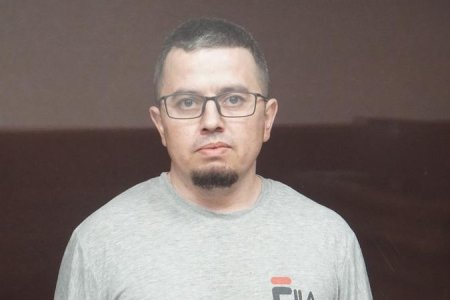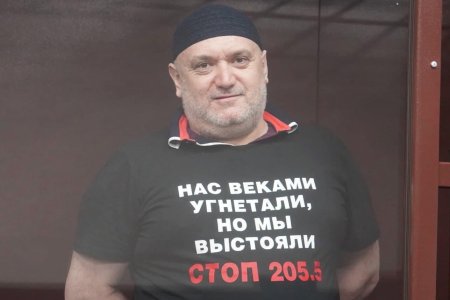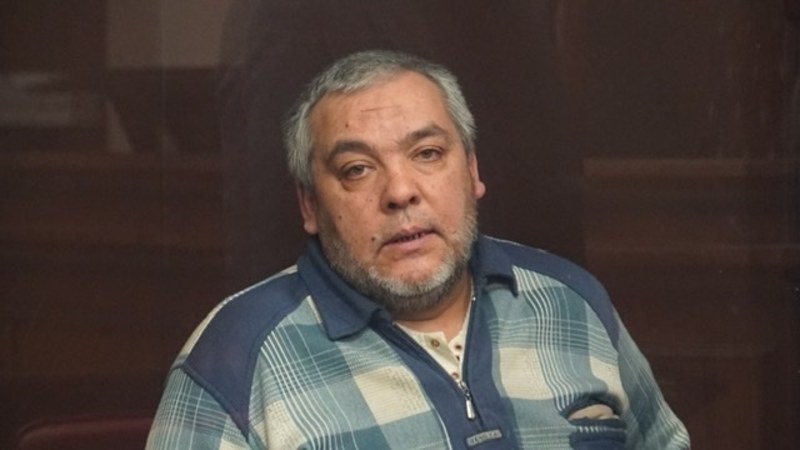
A court in Russia’s Kemerov oblast on 22 September 2026 rejected for the second time an application to release 56-year-old Yashar Shikhametov on medical grounds, although the recognized Crimean Tatar political prisoner has serious health issues and should not be imprisoned. Over the past year, Russian courts have either succumbed to pressure from the prosecutor (or FSB) and withdrawn earlier, entirely correct, rulings ordering the release of a gravely ill Crimean political prisoner, or have resorted to falsifying medical documents and postponing court hearings to avoid releasing political prisoner Tofik Abdulgaziev, who has a malignant brain tumour. It is becoming disturbingly clear that, in the case of Crimean Tatar and other Ukrainian political prisoners, the Russian authorities know no mercy and see no problem with flouting their own regulations where these confirm medical grounds for early release.
The same Yaisky district court in Kemerov oblast first rejected an application for Shikhametov’s release in the summer of 2025, although he had undergone medical tests which confirmed serious medical conditions, and which have since led to his receiving Grade III Disability status. In September 2025, it was reported that Shikhametov had lost about 30 kilograms, was suffering acute chest and spinal pain, as well as chronic knee, hip and foot joint pain, with all of this making him almost unable to walk except small distances on crutches. was already almost unable to walk. Using the crutches, in turn, causes acute pain in his shoulders and arm joints, yet he has not received a proper medical examination, nor the wheelchair to which such disability status entitles him. The prison doctors give him medication without explaining what it is for, and he is probably mainly receiving painkillers, which create further medical issues if used over a long period.
Even during his trial back in 2022, Shikhametov was in very poor health, with chronically high blood pressure causing heart, stomach, liver and spinal problems. After five years in appalling prison conditions, he has Stage 3, or severe, hypertension, with readings of over 200 mm/HG. He has kidney stones and has suffered a severe deterioration in his eyesight.
Yashar Shikhametov is from Orlinoye on the outskirts of occupied Sevastopol. He earlier appeared as a defence witness in the political trial of Enver Seitosmanov, which may have been the reason that the Russian FSB turned their attention to him. They added him, six years after the earlier arrests in 2015, to Russia’s first conveyor belt ‘trial’ of Crimean Muslims on charges of involvement in Hizb ut-Tahrir. The latter is a peaceful, if controversial, transnational Muslim organization which is legal in Ukraine. Russia’s prosecutions, under ‘terrorism’ legislation, are based solely on an extremely secretive Russian Supreme Court ruling from February 2003, which declared the organization ‘terrorist’ without providing any grounds or explanation.
Shikhametov was charged under Article 205.5 § 2 of Russia’s criminal code with ‘involvement’ in a Hizb ut-Tahrir group. This was seemingly the same fictitious ‘group’ which the FSB claimed that Ruslan Zeytullaev had ‘organized’ (a more serious charge) and that Ferat Saifullaevy; Yury Primov and Rustem Vaitov were supposed to have been members of. Russia was still ‘testing the ground’ (and international reaction) in that case and all of the men initially received much lower sentences than required by legislation. The prosecution (or, more likely, the FSB) challenged the sentence against Zeytullaev until they got a 15-year sentence but did not appeal against the other three sentences (see: Crimean Tatar political prisoner ‘retried’ until Russia’s FSB got the sentence they wanted) By 2021, the Russian FSB were standardly adding a second surreal charge, of ‘planning to violently seize power’ under Article 278 of Russia’s criminal code. This is based solely on claims made about Hizb ut-Tahrir, and it is evident that the FSB, when staging armed ‘searches’, never make any pretence of looking for anything except ‘prohibited religious literature’.
This was the case on 17 February 2021 when armed and masked enforcement officers burst into Shikhametov’s home and carried out ‘a search’, before taking the father of three away and imprisoning him. As in all such cases, lawyers were illegally prevented from being present. The officers claimed to have found three ‘prohibited religious books’. The books, which did not have any fingerprints on them, were in a cupboard holding coats and shoes which was a place, as Shikhametov himself told the court, that no practising Muslim would hold religious literature.
During one of the hearings, Shikhametov stated that he considered the real criminals to be those who planted ‘prohibited books’ in his home. Typically, the only outcome of this was that Shikhametov himself was removed from the courtroom. Shikhametov has been open in calling those involved in this prosecution and others “accomplices and criminals” and this was not the only time he was removed from the courtroom.
Both the earlier ‘trials’ and that against Shikhametov were, as the latter said, based on ‘conversations in the kitchen’ on religious and political subjects. These were sent to FSB-loyal ‘experts’ (from the Kazan Inter-regional Centre for Analysis and Assessments) who provide the opinion demanded of them.
Shikhametov’s medical issues meant that a number of hearings needed to be adjourned. They also made him unable to speak during the final, ‘debate’, part of the hearings, with presiding judge Alexei Magomadov falsely claiming that Shikhametov had “voluntarily renounced his right to speak.” Shikhametov had planned, in his address, to say the following: “Did we really have a choice in 2014? I will tell you that it’s all true: we are Crimean Tatars by nationality; our religion and culture is Islam; and we are citizens of Ukraine. Is that proof of my guilt? We are not in hiding, we do not conceal that and openly speak of it everywhere. Is that really a crime? All is fabricated by an FSB investigator out of conversations in the kitchen, with searches for intimidation and tormenting people.”
During the trial at the Southern District Military Court in Rostov, prosecutor Sergei Aidinov did not succeed in explaining how Shikhametov, working as a café chef was supposed to have ‘carried out ideological work’ or what such ‘work’ was.
All of this was ignored by Alexei Magamadov, together with Kirill Krivtsov and V.Y. Tsybulik who actively took the side of the prosecution. Magamadov not only allowed the use of ‘secret witnesses’, whose testimony could not be verified, but actively blocked questions aimed at demonstrating that the person is lying.
It was on the basis of ‘secret witnesses’ who may have never set eyes on Shikhametov, as well as planted religious literature and flawed ‘analyses’ by FSB-loyal ‘experts’ of ‘kitchen conversations about religion and politics’, that Yashar Shikhametov was sentenced on 9 September 2022 to 11 years’ maximum-security imprisonment, with the first four years in a prison, the harshest of Russia’s penal institutions.