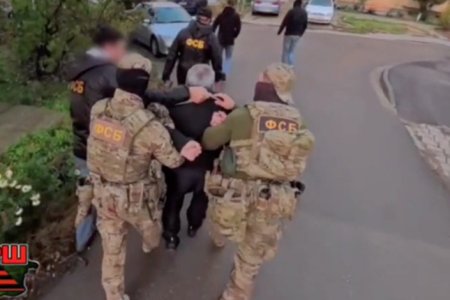
The Soviet regime called criticism ‘anti-Soviet agitation and propaganda’ and sentenced so-called ‘repeat offenders’ to ten years. Russia’s notorious Southern District Military Court on 10 November 2026 sentenced 24-year-old Nestor Shtormovy [or Shtormovoy, in Russian] from occupied Crimea to 20 years’ maximum-security imprisonment for a film expressing opposition to Russia’s occupation and clearly identifying Crimea as part of Ukraine.
Russia has not quite dropped all pretence. While using virtually identical terminology to that during Soviet times, it also gets the Russian supreme court and other judicial bodies to outlaw dissident organizations and even divisions of Ukraine’s Armed Forces by claiming them to be ‘terrorist organizations’. Those rulings are then treated as sufficient grounds for bringing ‘terrorism’ charges and passing massive sentences.
This was the case with Russia’s persecution of Nestor Shtormovy (b. 2002) who was abducted and disappeared back on 22 March 2025. There is disturbingly little information about the young man who appears to have been known as Nestor Laponohov until 2021 and is from Oktiabrske, an urban settlement in the Krasnohvardiiske district. There is only the LisaAlert message reporting him missing in April 2025 and the news of the sentence on 10 November 2026. The indictment was only passed to the Southern District Military Court on 24 June 2026, and it is possible that the young man was held incommunicado, without formal status or charges, for a year or more before being officially charged and remanded in custody. Such periods are standardly used to extract ‘confessions’ and / or ‘evidence’, more often than not through torture.
Even after the ‘’case’ reached the court, there remained no way of following it as Nestor Shtormovy’s name was concealed, and the first report of the charges appears to have come with the news of his sentence.
The young man was charged with ‘state treason’ (under Article 275 of Russia’s criminal code) and with ‘involvement in something that has, in the RF, been designated a terrorist organization (Article 205.5 § 2).
The supposedly ‘terrorist’ organization in question is ATESH, which is a partisan resistance movement of Crimean Tatars and other Ukrainians. ATESH members collect information on Russian military movements, with such information having helped some of the Ukrainian strikes on Russian military sites in Crimea or in the sea around it. The movement stresses that their targets are solely the Russian military and collaborators who have betrayed Ukraine and are helping the invaders.
The prosecution claimed that Shtormovoy had established contact with a member of ATESH and had expressed his willingness to help the organization and “carry out one of the directions of their activities, namely influencing the public, executive bodies and individuals. This is so as to achieve political and other aims by information and propaganda work on discrediting the Russian Federation’s policies and authorities by preparing an anti-Russian agitation and propaganda film.”
From 1 August 2024 through 22 March 2025, Shtormovoi had, allegedly, prepared the script of “an anti-Russian agitation and propaganda clip and made video recordings in various places in Sevastopol, including with the participation of another person as an actor”.
Calling it “an anti-Russian agitation and propaganda clip’ for a third time, the indictment claims that the film was aimed at “distorting historical facts and reality, setting public opinion against the RF as a state; inciting enmity or hatred towards the actions of the official Russian authorities; Russian nationality; denying that Crimea joined the RF; creating a negative image of Russia’s armed forces…”
While unclear what the clip held, it is Russia that has spent the last 12 years trying to rewrite the facts about its invasion and annexation of Crimea. In the version presented, for example, in school history textbooks, no mention is made of the soldiers without insignia who seized control in 2014, Ukraine is accused of ‘beginning the war against Russia’, and similar nonsense. In denying that Crimea “joined the RF”, the video would be in full accordance with the United Nations General Assembly, all democratic countries and international law. All of these, it should be stress, condemn Russia’s foisting of its citizenship on Crimeans and others living on occupied territory, with this citizenship used as excuse for the charge of ‘state treason’.
In all of Russia’s profoundly flawed ‘trials’ of Crimean Tatar and other Ukrainian political prisoners, the mere fact of a supreme court ruling claiming that an organization is ‘terrorist’ is deemed enough to warrant massive sentences.
In this case, Nestor Shtormovy was sentenced to 20 years’ maximum-security imprisonment, with the first five years in a prison, the harshest of Russia’s penal institutions. The sentence was passed by ‘judge’ Denis Aleksandrovich Galkin, an individual involved in multiple ‘trials’ of Ukrainian political prisoners. There had been only three hearings, all behind closed doors, before Galkin ‘retired’ to prepare the verdict and sentence on 10 November 2026, with these announced a mere three hours later.
During one of the demonstrations against Russia’s invasion and occupation in early 2014, one of the placards read: “Supporters of Putin! Under Putin, you won’t speak Russian, you will BE SILENT in Russian!”.
The terror began immediately, and, since 2022, has become widespread and ferocious. The following are just the most recent cases of harsh reprisals for expressing the internationally recognized position of Crimea.
Viacheslav Nikiforenko
Ukrainian sentenced to 15 years for opposition to Russian occupation in social media posts
Serhiy Obushny
Crimean pensioner sentenced to six years for social media comments against Russian aggression
Tetiana Deviatkina
Russian invaders sentence Tetiana Deviatkina to 6 years for criticizing them on social media
Russia brings long sentences for pro-Ukrainian social media posts to occupied Ukraine