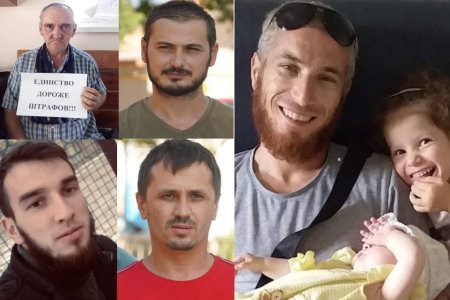
A Russian prosecutor has demanded three 19-year sentences and one of 16 years against four Crimean Solidarity journalists and activists who refused to look away as fellow Crimeans faced persecution. All of the men have very young children and not one is accused of any recognizable crime. All had, however, earlier faced various forms of harassment for their peaceful civic activism in support of political prisoners.
The trial of Rustem Osmanov (b. 16.01.1989); Mustafa Abduramanov (b. 1.04.1988); Memet Liumanov (b. 26.07.1988) and Aziz Azizov (b. 6.08.1995), is reaching an end six months after Russia effectively outlawed Crimean Solidarity by labelling it a ‘foreign agent’. It was almost certainly because courageous people like the four men now on ‘trial’, refused to be silenced that Russia finally dropped all pretence and imposed a blanket ban. That the men were targeted for their Crimean Solidarity activism is scarcely even denied, with Memet Liumanov already added to the extended list of so-called ‘foreign agents’ for links to Crimean Solidarity, together with 136 other lawyers defending political prisoners; journalists, activists, and relatives of political prisoners.
Rustem Osmanov is a journalist by profession, who had worked as a film editor for the Crimean Tatar TV channel ATR until Russia forced the channel to stop broadcasting and it moved to Kyiv. Rustem remained in Crimea and, from 2016 was involved, as a journalist and activist, in Crimean Solidarity. Both Mustafa Abduramanov and Memet Liumanov were activists for the movement, while Aziz Azizov was a streamer and civic journalist. Crimean Solidarity played a vital role in ensuring that people learned about the mounting repression in occupied Crimea. Its activists attended political trials; would gather near the homes of people facing armed searches and actively supported political prisoners and their families. This was not to the aggressor state’s liking and the four men are among a large number of Crimean Solidarity journalists and activists who first faced administrative prosecutions and were then arrested after they refused to be intimidated into silence.
The trial, which began in October 2024, is taking place at the Southern District Military Court in Rostov, as have all such previous trials. The charges, as well as the methods used to fabricate evidence, have changed little over the past ten years, with the only real difference being that the sentences are becoming longer. Russia’s FSB accuses them solely of some kind of ‘involvement’ in Hizb ut-Tahrir, a peaceful, if controversial, transnational Muslim organization which is legal in Ukraine. Russia’s supreme court never explained its ruling in 2003 which declared Hizb ut-Tahrir a ‘terrorist organization’, nor why it kept the ruling secret until it was too late for the organization itself or human rights groups to challenge it.
Nor is this the only problem with such prosecutions. The defence has shown that the charges are illegal because the supreme court ruling predates the introduction in 2006 of Russia’s law on countering terrorism. An indictment since then must point to the specific articles and norms of that law which the defendants are alleged to have violated.
This is such an indisputable and glaring flaw in such trials that the defence did achieve a break in the proceedings in June 2025. This was, purportedly, in order to begin a new trial, one, presumably, in accordance with the law. That, however, is entirely impossible as all these ‘trials’ and massive sentences hinge purely on the fact of the 2003 supreme court ruling and on unproven charges of ‘involvement’ in an organization that also does not fit the definition for a terrorist organization. The old trial, with the same fatal flaw, simply resumed in late September 2025.
Three of the men – Rustem Osmanov; Mustafa Abduramanov and Memet Liumanov are accused of being ‘organizers’ of a supposed Hizb ut-Tahrir group under Article 205.5 § 1 of Russia’s criminal code. Aziz Azizov is accused of the lesser charge of ‘involvement in a terrorist organization’ under Article 205.5 § 2.
All four civic activists, who have young families, are also charged, under Article 278, with ‘actions aimed at the violent seizure of power or violent retention of power in violation of the Russian constitution, as well as aimed at violently changing Russia’s constitutional order’ This entirely surreal charge is laid without any explanation. The men are not accused of any specific actions and the armed and masked men who burst into their homes on 5 March 2024 never made any pretence of searching for weapons, explosives, etc., only ‘prohibited religious literature’. The only ‘evidence’ to back the claim of ‘involvement in Hizb ut-Tahrir’ comes from a secret witness whose identity is concealed. The defence believes that this same individual has been used in around ten other ‘trials’ of political prisoners, with the court not only ignoring the lack of any grounds for a person hiding his identity but actively blocking defence questions aimed solely at demonstrating that he is lying. Russia’s reliance on such ‘anonymous witnesses’ was found in violation of a European Court of Human Rights ruling while Russia was still a party to the European Convention and bound by such judgements. It was also condemned by the UN Secretary General in his 2021 report on the situation in occupied Crimea.
The prosecutor on 17 November 2026 demanded 19 years against Osmanov, Abduramanov and Liumanov, and 16 years against Azizov. In all four cases, the prosecutor asks for the first five years to be in a prison, the harshest of Russia’s penal institutions, and the rest in a maximum-security prison colony. He also asked for a further two years of restricted liberty after the sentence.
Rustem Osmanov is not just a journalist, who was ensuring that people knew what was happening in Crimea. He is also the father of 12-year-old Musa (b. 11.09.2014) and 9-year-old Ariya (b. 07.04.2017). Memet Liumanov has four children –12-year-old Bilial; Sabil (10(; Abdulla and a daughter from his first marriage. Mustafa Abduramanov’s four children are 11-year-old Diliara, Saifullakh (10), Sanniye (7), Riza-Ali (5), while Aziz Azizov has three children – Salakhudin who is 8, Shukri (6) and Suleiman (4).
This is the latest such ‘trial’ at the notorious Southern District Military Court in Rostov with the outcome tragically clear since 5 March 2024 when the men were first taken into custody. The hearings have been before ‘judge’ Igor Vladimirovich Kostin who has already taken part in passing massive sentences against Crimean Tatar and other Ukrainian political prisoners.
The next hearing, where the men will probably give their final address, is scheduled for 8 December.
There is one other critical difference about this ‘trial’, namely that it is ending after Russia has crushed Crimean Solidarity, placing human rights lawyers, civic journalists and activists in occupied Crimea in danger of arrest if they circulate information. Please help to ensure that these travesties of justice receive publicity!