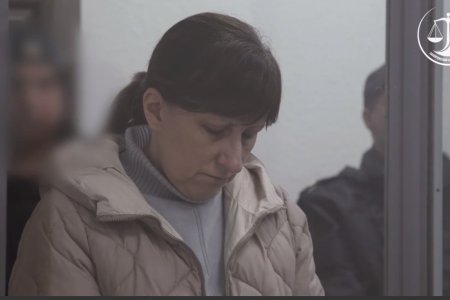
It became known that the woman has serious health problems from a report by the outlet Mediazona. The journalists cite a letter the prisoner sent at the end of October.
According to Olha, in 2021 her thyroid cancer returned, with metastases in her neck, under her arms and elsewhere. In March 2022 she was due to travel to Kyiv for chemotherapy and surgery, but then the full-scale invasion began. After that, Olha Sidachova-Shakhova could no longer get treatment because she did not have a Russian passport. She also suffers from chronic laryngeal stenosis, bronchial asthma, severe hypothyroidism and other illnesses.
Olha’s health is now deteriorating rapidly. She is 167 cm tall and weighs barely 40 kg; she cannot eat properly and sleeps badly because of the stenosis. “My neck hurts very badly, where the nodes are,” she says. Because of this, she has to take painkillers constantly. But all she has access to is ibuprofen, which helps only briefly. The medicines she needs are not being passed on to her. “I’m holding on for now; it’s a constant fight for the right to live,” Olha wrote in her letter.
The human rights defender’s case
Olha Sidachova-Shakhova lived in Nova Maiachka in Kherson region. Before the full-scale invasion, she worked as a human rights defender, was a member of the NGO Human Rights Association “Syndicate”, and worked as a journalist. In 2019 she sat on the Public Council of the Southern Interregional Department for the Execution of Criminal Sentences and Probation of Ukraine’s Ministry of Justice.
The exact date of her detention is unknown. According to Mediazona, it happened no later than 25 February 2026, when her name was added to Russia’s “list of extremists and terrorists”. As reported by Memorial’s project supporting political prisoners, Olha was initially charged under the article on “justification of terrorism”.
On 16 July the court handed down its verdict: a fine of 320,000 roubles. Olha was supposed to be released two weeks later. “On 1 August I was supposedly set free, but before I could even leave the SIZO, I was detained again, this time under a different article. I am being charged under Article 276 (espionage) of the Russian Criminal Code. I never made it home,” she wrote in her letter.
Olha is very worried about her son, who may already have been taken into the Russian army. While in captivity, she has repeatedly tried to contact her family, but Nova Maiachka has no electricity or communications, and the post does not work. “I had contact with my niece, but I lost touch with her too… From her I learned that my son was supposed to be taken into the army on 1 October,” Olha wrote in October.
Serious illness behind bars
Among the Ukrainian civilians unlawfully held by Russia, many suffer from cancer and other serious illnesses. Despite this, Russia continues to hold them. And when it does release them, it is only once their health has already suffered irreparable damage. Here are just a few examples.
We have written about Lenur Khalilov. He was detained on 10 June 2019 in the “Hizb ut-Tahrir case” and on 16 August 2021 was sentenced to 18 years in a maximum-security colony as the “organizer of a terrorist cell”. While already in custody, he was diagnosed with liver cancer that had spread to the lymph nodes. In August 2025, a district court in Arkhangelsk released him on health grounds. But after Lenur Khalilov returned home, the Russian prosecutor’s office appealed the ruling. In November 2025, Khalilov was returned to the colony in Arkhangelsk. The cancer has already reached the terminal stage, Khalilov can barely move on his own, and the prison hospital cannot provide adequate treatment. In October this year it became known that the Isakogorsky District Court of Arkhangelsk had refused to release the terminally ill Crimean Tatar Lenur Khalilov on health grounds.
Kateryna Kuzmenko, a resident of Novoaidar, served as a medic in the 24th Separate Assault Battalion “Aidar” of the Armed Forces of Ukraine from August 2015 to February 2017. She left the service when she learned of a serious diagnosis: multiple sclerosis. On 6 October 2023, a Russian court sent her to prison for 5 years, even though with this illness she needs constant treatment and care.
Dmytro Shurda, a well-known Mariupol boxing coach and referee, has remained in captivity since March 2022, when he was detained at a checkpoint. According to a former cellmate, Shurda suffered strokes while held in Horlivka, and he was later diagnosed with tuberculosis and HIV. He has also survived two heart attacks. In 2024 he was transferred to Altai Krai, and then to a SIZO in Vyazma.
Tofik Abdulgaziev, a member of the Crimean Solidarity movement, has finally been released from serving his sentence, but in a very serious condition. He had been behind bars since March 2019. In 2022, the Russians sentenced him to 12 years for involvement in the Hizb ut-Tahrir movement. Doctors confirmed that he has glioblastoma, a malignant brain tumour. He was also found to have disseminated pulmonary tuberculosis, heart failure, anaemia and other illnesses. He has lost a great deal of weight and has partially lost his sight. In February 2026, before a court hearing on his release on health grounds, prison doctors, in the presence of the FSB, forced him to sign a document stating that he was healthy. He had a high fever at the time. The hearings on his release were postponed several times. On 26 October 2026, the Metallurgichesky District Court of Chelyabinsk finally ordered Tofik Abdulgaziev’s release on health grounds.
Oleh Kotov was a civilian captive whom the Russians unlawfully imprisoned in 2022 during the occupation of Kharkiv region. In captivity he developed cancer, but received no treatment apart from a few injections. He returned home in a prisoner exchange in June this year. He died at the end of July in a hospital in Kyiv.
By persecuting civilians in the occupied territories of Ukraine, Russia violates a whole range of norms of international humanitarian law. Russia imposes its own criminal legislation, even though this contravenes Article 64 of the Fourth Geneva Convention. Civilians are subjected to enforced disappearances, and procedural rules are observed only formally. Abducted civilians are transferred to Russian territory, even though such actions are prohibited by Article 76 of the Convention relative to the Protection of Civilian Persons. Moreover, the denial of medical care to Ukrainian captives held by Russia can in itself be considered torture.