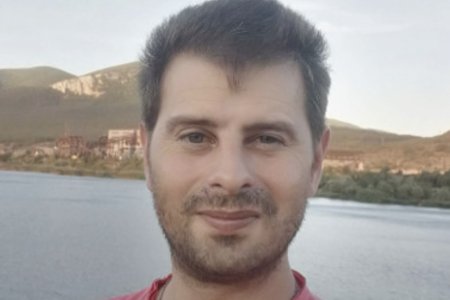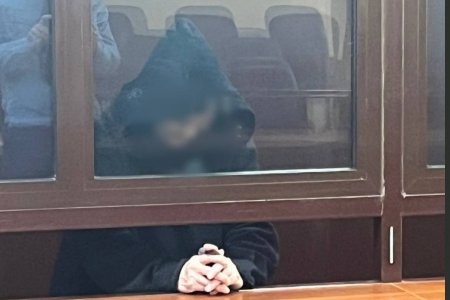
Russia’s occupation ‘Crimean high court’ on 13 March 2026 found Charaz Akimov (b. 27.12.1993) guilty of ‘state treason’ and sentenced him to an appalling 18 years’ maximum-security imprisonment. The case is especially shocking as the 32-year-old Crimean Tatar from Yalta was initially sentenced to five years’ medium-security imprisonment for supposed ‘collaboration on a confidential basis with a foreign state’, a less severe charge which the FSB would not have brought had they had any evidence to bring graver charges. There remained no evidence, just the will to increase the sentence and a ‘judge’ who had already passed several politically motivated sentences and could be relied upon to provide the sentence demanded here.
The indictment was unchanged, with Akimov accused of having made a brief video of vessels from Russia’s Black Sea Fleet in the Southern Bay which he had, allegedly, sent to an officer of Ukraine’s Military Intelligence. Russia’s military use of both the fleet and occupied Crimea for its war of aggression against Ukraine make any such vessels an entirely legitimate target for strikes by Ukraine. It is, nonetheless, difficult to imagine that a layperson’s video would have provided any information to Ukraine’s Military Intelligence that the latter could not obtain by other means.
It is telling that the authoritative Memorial Support for Political Prisoners Project had declared Charaz Akimov a political prisoner even before the original five-year sentence. The reasons include the flawed, and political, nature of the charge under Article 275.1 of Russia’s criminal code, which, in full, punishes for what is claimed to be “cooperation on a confidential basis with a representative of a foreign state, international or foreign organization in order to help it in activities which are knowingly aimed against the security of the Russian Federation”). The Article is in clear breach of principles of law, and Russia’s constitution. The fact that Akimov was accused specifically under this unlawful charge, Memorial stated, “suggests that there were no grounds, in principle, for criminal prosecution over the claimed actions.”
Akimov was, seemingly, sentenced on 26 November 2024 to an undisclosed, but probably small, term of imprisonment, supposedly for several instances of driving under the influence of alcohol (Article 264 § 1 of Russia’s criminal code). This feels like a pretext for detaining Akimov, with suspicion further fuelled by the fact that the FSB announced his ‘arrest’ for supposed spying for Ukraine’s Military Intelligence on 17 December 2024, although the video footage suggests that he had been seized in the summer or early autumn.
Crimean Process cites human rights groups in noting that Akimov had been held incommunicado for a long time, with the FSB denying that he was in their custody. It was, doubtless, during this period that his videoed ‘confession’ was obtained. This ‘confession’ essentially repeats the allegations used to sentence him 3 April 2025 to 5 years medium-security imprisonment on a charge of ‘collaboration on a confidential basis with a foreign state’ under Article 275.1, and then, on 13 March 2026, to 18 years’ maximum-security imprisonment. Both claimed that Akimov had, from July 2023 through March 2024, contacted an employee of Ukraine’s Military Intelligence on Telegram and had offered to provide various information, including photos and videos. In December 2023, he had, purportedly, videoed the movement of Black Sea Fleet vessels in the Southern Bay.
The video has Akimov saying: “They wrote to me saying that you can, as a citizen of Ukraine, help the Ukrainian authorities to follow the movements of military technology. I agreed. I sent a photo of my Ukrainian passport.”
In the winter of 2023, he says, he had received two tasks, the first being to come to Sevastopol and video the movement of boats in the Southern Bay. He did this in December 2023 and sent the brief video. After a while, he says, he received another task, to go to the Roshchynsk raion, where there are the FSB headquarters. The ‘confession’ does not make it clear what he was supposed to have done there, had he not been seized before that by the FSB.
The first sentence was passed on 3 April 2025 by ‘judge’ Alla Nikolaevna Khinkevych from the occupation ‘Crimean high court’. She convicted Akimov of ‘collaboration on a confidential basis with a foreign state’ under Article 275.1 and sentenced him to five years in a medium-security prison colony. She added the unserved part of the previous sentence, supposedly for drunken driving, passed in November 2024 under Article 264.1 § 1. If this previous sentence was for genuine offences, and not merely a pretext for holding Akimov imprisoned while the ‘spying’ charges were concocted, the size of the relevant sentences says it all. The combined two sentences came to five years and 25 days, with the same arithmetic on 13 March 2026 making the sentence 18 years and 20 days, albeit in much harsher conditions.
Appeals were lodged both by the defence and by the prosecutor, with ‘judge’ Kliment Igorevich Sutyagin from Russia’s Third court of appeal in general jurisdiction cases, revoking the sentence on 6 October 2025. It was claimed that there had been “incorrect application of Russia’s criminal law”. Russia’s application of its legislation on occupied territory is in violation of international law, but the ‘incorrect application’ here was merely a directive to charge Akimov with the far more serious ‘state treason’ under Article 275.
Crimean Process reports that there were three ‘hearings’, with these and the announcement of the sentence, held behind closed doors. The 18-year sentence (together with the added 20 days, and a subsequent one year and 10 months of restricted liberty) was passed by ‘judge’ Sergei Nikolaevich Pogrebnyak. Both Pogrebnyak and Khinkevych have been involved in other politically motivated ‘trials’. Both betrayed their oath to Ukraine and face legitimate charges of treason against their native country, unlike Charaz Akimov whom they have both taken part in imprisoning for a very long time.