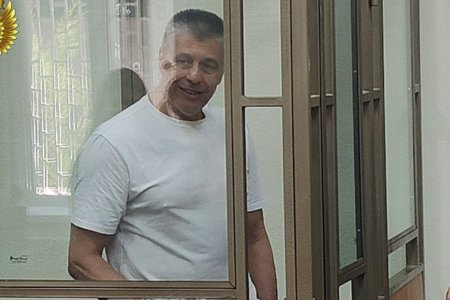
Ihor Boiko, a 61-year-old pensioner from Kerch in occupied Crimea, has been convicted by a Russian occupation ‘court’ of ‘treason’, under Article 275 of Russia’s criminal code, and sentenced to 18-years’ maximum security. Given the appalling conditions in Russian penal institutions, this would almost certainly prove to be an effective death sentence. All for video footage of a boat which could just as well be of a cormorant for all the interest or use that it could present for Ukraine’s Military Intelligence.
This is not, of course, the impression given by notorious collaborator Aleksandr Talipov’s Crimean SMERSH Telegram channel. That calls Boiko “a Ukrainian agent” recruited by officers of Ukraine’s Security Service [SBU]. It claims that he used WhatsApp to pass on information about Russia’s Black Fleet in the Kerch Strait.
Crimean Tribunal presents a quite different picture. The 61-year-old Ukrainian from Kerch was accused of having videoed a patrol boat and sent the video to a friend, with the latter alleged to have passed this on to Ukraine’s Military Intelligence. The human rights initiative suggests substituting a boat with a cormorant. “Whether one or the other, the video would not represent either a) a state secret, nor b) any interest to Military Intelligence given the unsystematic and fleeting nature of the surveillance.”
The assertion that a friend was supposed to pass the video footage to the SBU means that there is nothing to directly link Boiko with Ukraine’s Security Service. Nothing, Crimean Tribunal suggests, but a supposed ‘confession’ from Boiko himself who has probably been in FSB captivity for a long time. Any such ‘testimony’ is typically obtained through torture, threats or other forms of duress while a person is held incommunicado and without access to a proper lawyer. With regard to politically motivated prosecutions in occupied Crimea, there have been several cases where defendants are shown on propaganda videos, ‘confessing’ to ‘treason’. ‘spying’ or ‘terrorism’ which is then left out of any indictment and never mentioned.
The sentence was passed on, or shortly before, 5 May 2026 by ‘judge’ Natalia Kulinskaya from the occupation ‘Crimean high court’. Kulinskaya was very likely promoted from the ‘municipal court’ in Feodosia after she demonstrated her willingness to take part in the persecution of Ukrainian civic journalist and human rights defender, Iryna Danilovych. She has remained an active player in Russia’s machine of political repression, with a 13-year sentence against Ismail Shemshedinov and 15-year sentence against Niyara Ersmambetova, who has two young children and an elderly father with disability status. In Boiko’s case, he would be 79 if he survived to the end of the 18-year sentence in a maximum-security prison colony and then had a further one-year period of restricted liberty. Kulinskaya also imposed a huge 400-thousand rouble fine.
It is not only Kulinskaya’s involvement that raises legitimate concerns about Boiko’s ‘trial’. There is no information regarding when he was taken into custody and he is very likely to have been held incommunicado for some time, with no official status and no access to an independent lawyer. Crimean Process reports that there were six ‘hearings’, all behind closed doors, with no way of monitoring observance or the lack of such of fundamental principles of a fair trial.
This is one of numerous monstrous sentences against Ukrainians over alleged videos or other information that was either on open access, or that would not have been of any real interest even had there been proof of it being passed to Ukraine’s Security Service or Military Intelligence. All are held behind closed doors, normally after a person has been abducted and held for long periods without any contact with the outside world.
See:
Charaz Akimov (b. 27.12.1993)
Crimean sentenced to 18 years for a phone video of boats from Russia’s Black Sea Fleet
Ihor Bunin (b. 13.01.1979)
Russia sentences Crimean to 15 years for sharing information available on Google Maps
Serdar Izmailov, others
Terror behind closed doors: Russia’s abductions, torture and monstrous sentences in occupied Crimea