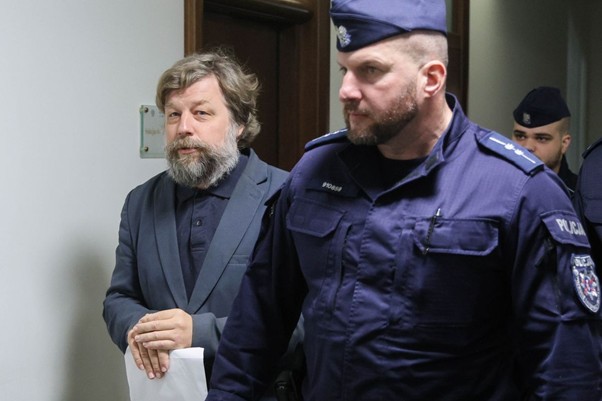
The Warsaw Circuit Court gave its consent on 18 March for the extradition to Ukraine of Russian archaeologist Alexander Butyagin on charges linked with illegal excavations in occupied Crimea. The ruling by Judge Dariusz Lubowski is not final as Butyagin’s lawyer, Adam Domański has already said that an appeal will be lodged. The court was, furthermore, asked only whether Butyagin could be extradited to Ukraine, with the decision as to whether he will be extradited ultimately up to Poland’s Minister of Justice. This is, nonetheless, a victory for Ukraine and also sets an important precedent. As Butyagin’s lawyer himself acknowledged, the court had not been convinced by their arguments, which had included the claim that Butyagin’s life would be in danger if extradited to Ukraine and that he would not get a fair trial in a Ukrainian court. The precedent had clearly been noted after Butyagin’s arrest in early December 2025. By the end of January 2026, Russia’s ministry of science and higher education had advised educational and research institutes that their employees should carefully assess whether they should travel to what the current Russian regime views as ‘unfriendly countries’.
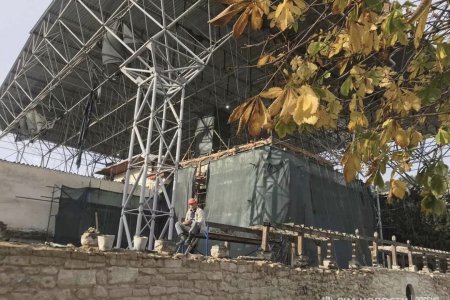
Alexander Butyagin (b. 1971) is accused by Ukraine of carrying out excavation work on a site of Ukrainian cultural heritage, namely Myrmēkion, an ancient Greek colony founded in the first half of the sixth century in what is now Kerch in Crimea without the required permission (under Article 298 § 4 of Ukraine’s Criminal Code) and of causing its partial destruction. The notice of war sanctions, imposed by Ukraine points out that in 2022 he led an expedition which discovered and illegally seized for the Russian Federation thirty gold coins, of which 26 were inscribed with the name of Alexander the Great and 4 were minted during the reign of his brother Philip ΙΙΙ Arridaeus.
Butyagin was informed of the charges back in November 2024 and spoke of them dismissively in an interview to the Russian state-controlled RIA Novosti, He expressed “surprise that at that at such a difficult time for Ukraine”, Kyiv prosecutors should be engaged in what he called “the persecution of archaeologists”.
Butyagin has, apparently, been involved in excavations at Myrmēkion since 1999. The fact that he had done so legally before Russia’s invasion and annexation of Crimea in 2014 changes nothing. As a senior scholar at the most important of Russia’s state art museums, he continued to carry out such archaeological excavations without receiving permission from Ukraine and without travelling, as required, to Crimea from mainland Ukraine. He would certainly not have received such permission, but that is precisely because he was carrying out excavations for the occupying state and illegally taking artefacts of Ukraine’s cultural heritage to Russia.
Butyagin’s defence did not deny that the archaeologist had not, as required, received permission from Ukraine, but disputes the damage. Such questions are, in any case, for the trial in Ukraine, and not for an extradition hearing. It is, however, difficult to see how Butyagin could dispute the loss to Ukraine, through such effective looting, of Ukraine’s own artefacts.
Butyagin is in custody and doubtless careful what he says. Moscow has been far less circumspect. In their aggressive criticism of Poland for detaining Butyagin, they claimed that Butyagin had been carrying out excavations on what they called ‘an inalienable part of the Russian Federation.” It is inconceivable that Butyagin, when safely back in Russia, spoke in any other terms himself. He would not have retained his senior post at the Hermitage without effectively echoing the aggressor state’s position on Crimea, nor would he have been involved in organizing an expedition by Russian leader Vladimir Putin to Kerch.
On all Ukrainian territory that has fallen under Russian occupation, Russia has violated international law by excavating, ‘renovating’ and often plundering places of Ukrainian heritage. In Crimea has caused so much damage as to ensure that the Khan’s Palace in Bakhchysarai, which was on UNESCO’s World Heritage Tentative List has no chance of receiving the World Heritage recognition that it had undoubtedly deserved. The damage to Chersonese near Sevastopol, which is a UNESCO World Heritage site, has been no less devastating. In its report on the charges against the Hermitage archaeologist, Ukraine’s Prosecutor General pointed out that Russia was not just carrying out illegal excavations causing major damage to places of Ukrainian cultural heritage. It was also carrying out “unlawful restoration of such sites in order to distort Crimean history and demonstrate its [supposed] “Russian element’”.