Russian legislators have rushed through a bill which introduces criminal liability for denying something claimed to have been the “genocide of the Soviet people’ during World War II. Once rubberstamped by the Federation Council and signed into law by Russian leader Vladimir Putin, the bill will introduce possible sentences of up to three years’ imprisonment for denying a crime that nobody has ever clearly defined, and which the current Russian regime only began speaking about recently. While politicians claim that the new legislation will “defend historical memory”, it will doubtless serve to still further stifle historical discussion and to strengthen the punitive measures already used against those who speak honestly about Soviet crimes, including the Deportation of the Crimean Tatar people and the Katyń Massacre.
Considering that the Second World War ended in 1945, it is telling that the first mention of any “genocide of the Soviet people” came from Putin in 2020. It is Alexander Bastrykin, head of Russia’s Investigative Committee and a close Putin ally, who has pushed to criminalize ‘denial’ or ‘approval’ of this largely undefined ‘genocide’. Bastrykin has made scarcely no attempt to hide the purpose of such legislative moves, with the TASS report in November 2020 effectively linking Bastrykin’s call to legislate “the fact of the genocide of the Soviet people” with his anger over entirely warranted statements from the EU about the Soviet Union’s role in beginning the Second World War, together with Nazi Germany. This is precisely what happened, with the notorious Molotov-Ribbentrop secret protocols, carving up what was then Poland and leading directly to the invasions by first the Nazis, and then the Soviet Union. It is no accident that the current Russian regime reinstated the Soviet term ‘Great Patriotic War’, since this conveniently dates only from the Nazi invasion of 22 June 1941, and not the first 21 months of World War II when the USSR and Nazi Germany were close allies.
The bill in question was drawn up by deputies from the ruling ‘United Russia’ party and passed through its first reading in late February. It was then adopted unanimously at second and third readings on 24 March 2026. Duma speaker Vyacheslav Volodin claimed that the bill was needed “for the defence of historical memory” at a time when, according to him, “western politicians are trying to rewrite history and erase the truth about the heroic deed of the multinational Soviet people”.
The bill will come into force ten days after receiving Putin’s signature. It makes amendments to two articles of Russia’s criminal code. The words “victims of the genocide of the Soviet people” will be added to Article 243.4 “The destruction, damaging or desecration” of various burial sites, monuments, etc. “remembering those who died in the defence of the fatherland.”
There are also amendments to Article 354.1 on ‘the rehabilitation of Nazism”. This already punishes for anything that the regime decides is “circulation of knowingly false information about the activities of the USSR during the years of the Second World War” and for “circulating information demonstrating over disrespect to society about Russia’s days of military glory and remembrance insulting the memory of defenders of the Fatherland”, etc. It will now also include “denial of the fact of the genocide of the Soviet people”.
Sentences for such ‘denial’ will range from a fine of up to 3 million roubles to a three-year prison sentence. Approval of such alleged genocide, or desecration / destruction of monuments, etc., including those in other countries, will carry sentences from 5 million roubles in fines to imprisonment for five years.
In fact, the law on the so-called ‘rehabilitation of Nazism’, which came into force in May 2014, has already been deployed as a weapon against historical truth. It was used by a court in Perm and upheld by Russia’s Supreme Court, to prosecute Vladimir Luzgin for writing, quite correctly, that both Nazi Germany and the USSR invaded Poland in September 1939. In September 2023, another Russian court used the same norm to impose a massive, 2-million rouble, fine against Sergei Volkov for critical and entirely correct comments about the collaboration between the USSR and Nazi Germany for the first two years of World War II, and about Stalin in connection with the Siege of Leningrad. In late 2025, Enver Seitmemetov, a Crimean Tatar historian, was prosecuted under a similar administrative charge (Article 13.48). A Crimean occupation ‘court’ found him guilty of “publicly equating the aims, decisions and actions of the Soviet leadership with the aims, decisions and actions of the leaders of Nazi Germany” by stating in an interview that there should have been a tribunal, like that at Nuremberg, over Stalin’s 1944 Deportation of the entire Crimean Tatar people.
Speaking to the publication ‘Vot Kak’, Yevgeny Smirnov from the First Department [Pyerviy Otdel] Human Rights Initiative called the new bill the latest in a whole stream of insane laws and pointed out that the term ‘genocide of the Soviet people’ is nowhere adequately defined. He did, however, suggest that the innovation would not have major legal implementation precisely because Article 354.1 already provides such ample opportunity for prosecuting people over questions regarding the activities of the Soviet authorities during WWII. Smirnov added that the bill could even be a PR move before coming ‘elections’ to the State Duma.
The sentences envisaged are steep for a ‘PR initiative’. For ‘denial’, they will range from a fine of up to 3 million roubles to a three-year prison sentence. Approval of such alleged genocide, or desecration / destruction of monuments, etc., including those in other countries, will carry sentences from 5 million roubles in fines to imprisonment for five years. “Vot Tak” also spoke with historian Mikhail Edelstein, who was equally negative about the bill, noting that “historical disputes are not resolved in the courts”. He fears that the law will have a chilling effect on people in his profession and notes that it will be even more difficult than it already is in Russia to study the Holocaust. “Official speakers” (Edelstein names Maria Zakharova as an example) have long proposed viewing the Holocaust more broadly, suggesting that the extermination of the Jews, of Roma Gypsies, should be viewed as part of the whole of Nazi genocidal acts. This new bill will make it even easier to ‘lose’ specific atrocities clearly directly solely against Jews as having been part of the so-called ‘genocide of the Soviet people’. The current regime is, yet again, reinstating the worst practises of the Soviet past, including the avoidance of the word genocide (and the fact that specific massacres, for example, were of Jews) and instead talking about the “mass killings of Soviet citizens.”
It is no accident that Moscow’s Gulag History Museum is to be replaced by a museum of the so-called ‘genocide of the Soviet people’. This ‘museum’ will focus solely on Nazi war crimes, with the new director, Natalia Kalashnikova, described as somebody who has taken part in Russia’s ‘special military operation’ (i.e. its war of aggression against Ukraine) and clearly viewed as ‘ideologically sound’.
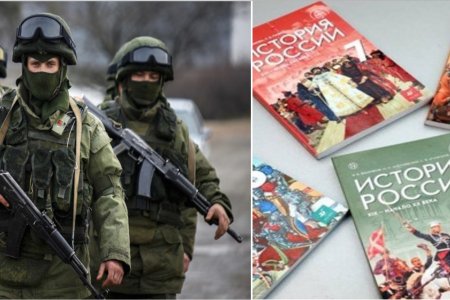
While unclear how many prosecutions are likely over such denial of an undefined ‘genocide’, the move is part of the current regime’s war against historical truth and use of legislation, the courts and some horrific sentences to stifle historical discussion and punish those, like Yury Dmitriev, who helped uncover the crimes of Stalin’s Terror and the mass graves at Sandarmokh. While claiming to be ‘defending historical memory’, Russia is aggressively rewriting history itself, and foisting textbooks on children in Russia and occupied Ukraine which deny Russia’s invasion of Crimea, the atrocities committed in Bucha, Mariupol, Izium and other totally irrefutable facts. The bill adopted on 24 March is just one of many legislative weapons which the regime is arming itself with to silence any dissenting voices.