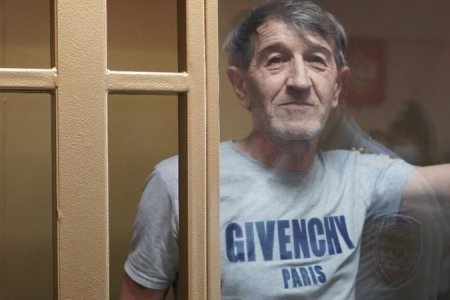
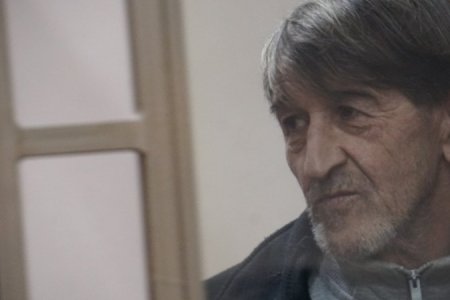
As feared, Russia has initiated yet another trial against Oleh Prykhodko, who has been in captivity on politically motivated charges since October 2019. The charges laid are based solely on unverifiable ‘testimony’ given by other prisoners who can easily be pressured or bribed into ‘cooperating’ with the FSB. More shocking still is the fact that this time, in order to ensure that the 67-year-old never leaves prison alive, ‘treason’ charges have been laid against a Ukrainian patriot targeted for his unconcealed opposition to Russia’s occupation of Crimea.
The indictment against Prykhodko was passed to the Southern District Military Court on 15 April 2026, with the case to be heard by Valery Sergeevich Opanasenko, a judge who has already been involved in trials against Crimean Tatar and other Ukrainian political prisoners. Prykhodko himself will probably be forced to take part by video link from the Krasnodar prison colony where he is currently imprisoned. He is, supposedly, represented by Yevgeny Igorevich Bazyliev, however it is likely that this is a state-appointed lawyer, not a person chosen by Prykhodko himself.
There are, in any case, no grounds for believing this to be a trial in any real sense and its outcome is essentially known in advance. Prykhodko has, this time, been charged with ‘abetting terrorism’, under Article 202.5.1 § 1.1 of Russia’s criminal code and with ‘incitement to treason’ under Articles 30 § 1; 33 § 4 and 275. The charges carry a sentence of up to life imprisonment.
It was, in fact, clear six weeks ago when the FSB first claimed to have “uncovered and stopped the criminal activities” of a prisoner, that the person in question was Oleh Prykhodko, b. 21.11.1958). The FSB press release asserted that this person had tried to persuade other prisoners to commit state treason by supposedly proposing to his cellmates that they sign a contract with the Russian ministry “to go to the special military operation zone”, i.e. to fight in Russia’s war of aggression against Ukraine. He had allegedly told them that they should then “cross over to the enemy’s side and join a Ukrainian terrorist organization banned in the RF”.
Serious charges carrying potential life sentences appear to be based on the ‘testimony’ of a fellow prisoner who is heard here asserting that he had told the person [Prykhodko] that he was planning to go to fight in Ukraine “to atone for my guilt before the motherland” The latter alone arouses suspicion that the prisoner is reciting what he has been prompted to say. Since the summer of 2022, Russia has been recruiting convicted prisoners to fight, offering them a lot of money, their freedom and, at least initially, a presidential pardon and completely clean slate. The individual goes on to claim that [Prykhodko’ “said I shouldn’t do that and that, even if you go there … if you shoot anybody from among the main commanders, you can surrender, and say “Glory to Ukraine!” and everything will be good, everything will be fine”.
Even if the words were genuinely spoken by Prykhodko, they would in no way justify the extraordinary charges and potential life sentence. The claim that this is ‘abetting terrorism’ is doubtless based on several politically motivated Russian supreme court or Southern District Military Court rulings, claiming that certain units of Ukraine’s Armed Forces (the Azov Regiment and others) are ‘terrorist organizations’.
This is the fourth time that Russia is using absurd charges to imprison or extend the sentence against Oleh Prykhodko. The original arrest and ‘trial’ took place before Russia’s full-scale invasion of Ukraine, when it was still possible to gain ongoing information about the proceedings.
Prykhodko was initially arrested on 9 October 2019 and charged with planning to blow up the Saki City Administration building, with this based primarily on ‘explosives’ allegedly found by the FSB in one of his two garages. Prykhodko’s open opposition to Russian occupation had already led to earlier harassment and administrative prosecutions and he had every reason to except FSB visitations and searches. This was just one of the reasons why it was unthinkable that he would have held a bucket full of explosives in his garage. Another was that he was a blacksmith by trade who used both garages for welding and soldering work, and would hardly have kept flammable substances near his equipment. A further reason for scepticism was that the FSB did not bother to search the second garage. Given the seriousness of the charges, this made sense only if they knew they would not find anything other than what they had brought with them.
The second charge only became clear three months later. Prykhodko was accused of having planned to set fire to the Russian general consulate building in Lviv, Western Ukraine, with the alleged ‘proof’ of this lying in a telephone and a memory stick. The defence was able to demonstrate that the ‘evidence’ had been falsified and to debunk this entire story. The details of such fabrication of criminal charges prompted the Memorial Human Rights Centre (now the Memorial Support for Political Prisoners Project) to declare Prykhodko a political prisoner.
The fabrication was, however, ignored by presiding ‘judge’ Alexei Abdulmazhitovich Magomadov; together with Kyrill Nikolayevich Krivtsov and Sergei Fedorovich Yarosh from the Southern District Military Court. On 3 March 2021, they found Prykhodko guilty of all charges, however removed the charge under Article 223.1 (preparing explosives) as being time-barred. It is clear that they understood that the charges bore no scrutiny as their sentence of 5 years’ maximum-security imprisonment was six years shorter than that demanded by prosecutor Sergei Aidinov.
An additional charge of ‘contempt of court’ (under Article 297 § 2 of Russia’s criminal code) was brought against Prykhodko after the initial sentence in March 2021. This was based on two incidents during the ‘trial’. One was when FSB officer Vladimir Stetsik gave ‘testimony’ about how he had supposedly found the explosives. Prykhodko’s language was extremely strong, and he was removed from the courtroom until the end of Stetsik’s questioning. Prykhodko later reacted with equally bad language when FSB officer Ivan Romanets said that he did ‘not remember’ the man who, in the first hours after his arrest, claimed to be a doctor and tricked Prykhodko into providing DNA without a lawyer present. That DNA was later claimed to have been found on the explosives. In the Spring of 2022, judge Konstantin Zaderko found him guilty of contempt of court, adding one month to the sentence Prykhodko was already serving.
The third sentence, on 8 November 2023, added 4.5 years to the five-year sentence against Prykhodko. Once again, the ‘testimony’ came from Prykhodko’s cellmates. They claimed that that Prykhodkho had “promoted acts of terrorism’ and “praised the actions of Hitler and his supporters during WWII”, with these unprovable assertions used as justification for serious charges. Prykhodko was accused and convicted of so-called ‘public calls to carry out terrorist activities, public justification of terrorism or propaganda of terrorism’ (Article 205.2 § 1 of Russia’s criminal code) and of the even more dubious ‘rehabilitation of Nazism’ under Article 354.1 § 1. This article of the criminal code, which purportedly punishes those who ‘publicly deny or approve of the facts established by the Nuremberg Tribunal’, was criticized before its introduction in May 2014, and has already proven to be a weapon against historical truth.
That sentence was reduced by a single month at appeal level on 8 March 2024.