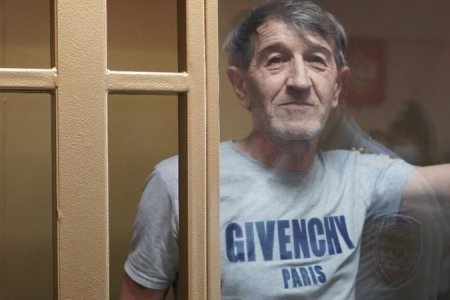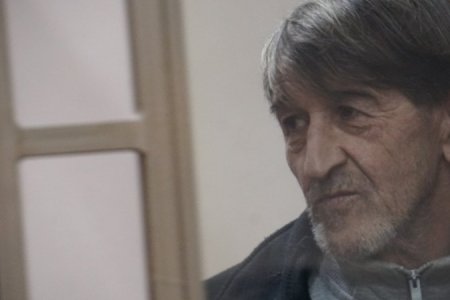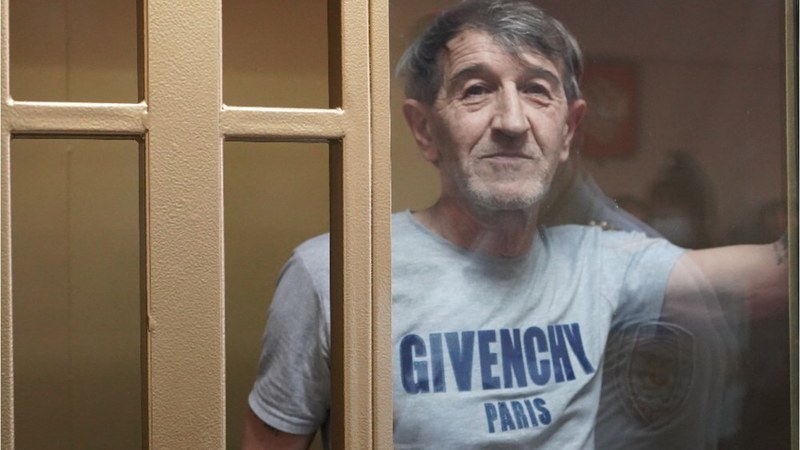
New charges based on alleged, and unprovable, conversations in prison could result in Russia dropping any pretence and sentencing 67-year-old Oleh Prykhodko to life imprisonment. Although no name was given in the TASS report, the details provided correspond to those of the Ukrainian political prisoner and a similar method was also used in 2023 to lengthen Prykhodko’s sentence.
The FSB circulated a press release on 5 March 2026, claiming that they and the Russian prison service had “uncovered and stopped the criminal activities” of a prisoner, described as a “Russian citizen, born in 1958”. It was alleged that he had made attempts to persuade other prisoners to commit state treason, with this, purportedly, being by proposing to his cellmates that they sign a contract with the Russian ministry to fight against Ukraine [the FSB report calls this “going to special military operation zone”] and that they then “cross over to the enemy’s side and join a Ukrainian terrorist organization banned in the RF”,
The Memorial Support for Political Prisoners Project has viewed the video also circulated by the FSB, on which an anonymous ‘prisoner’ makes the allegations against Prykhodko. The individual asserts that they were talking, and that he told the ‘accused’ that he was planning to go to fight in Ukraine. His claim that this is “to atone for my guilt before the motherland” already arouses scepticism. Russia began recruiting convicted prisoners to fight in the summer of 2022, with no words about ‘atonement’, but about a pragmatic deal, namely that the prisoners, in exchange, get a pardon, their freedom and a fair amount of money. The allegations against Prykhodko are no more convincing. “He said that I shouldn’t do that and that, even if you go there, if you shoot anyone from among the chief command and surrender and say “Glory to Ukraine!”, then everything will be fine for you, everything will be fantastic”.
In the vast majority of ‘trials’ of Crimean Tatar and other Ukrainian political prisoners, the main ‘evidence’ is provided by secret witnesses, whose testimony cannot be verified and who may have never set eyes on the defendant(s). The ‘testimony’ of anonymous cellmates would seem at least equally dubious. Probably more so, as it is significantly easier to make prisoners lives difficult if they do not provide the ‘testimony’ demanded.
The new charges are preposterously serious, given the flimsy nature of the allegations against the Ukrainian, who is almost certainly Prykhodko. He is accused of ‘abetting terrorist activities’, under Article 2025.1 § 1.1 of Russia’s criminal code and ‘planning to incite to state treason’, under Articles 30 § 1; 33 § 4 and 275. It is unclear from the few details given precisely how the prosecution will back the allegation about abetting terrorist activities. This is unlikely to be difficult, however, given that compliant Russian ‘courts’ have already been used to declare several units of Ukraine’s Armed Forces [the Azov Regiment, the Aidar Battalion, and others] ‘terrorist organizations’.
The FSB report notes that the charges laid can carry a sentence of up to life imprisonment. The point of this absurd prosecution is surely to ensure that the Ukrainian, who never concealed his opposition to Russia’s invasion and occupation of Crimea, and proudly flew the Ukrainian flag over his home, dies in Russian captivity.
Oleh Prykhodko was one of several Ukrainians in occupied Crimea to be arrested in late 2019 after the Kremlin was forced to release 35 Ukrainian political prisoners in exchange, primarily, for Volodymyr Tsemakh, a vital MH17 witness whom the Dutch prosecutor wanted to question.
Prykhodko’s persecution was, from the outset, very reminiscent of that against one of the released political prisoners, Volodymyr Balukh, another Ukrainian who openly expressed his opposition to Russian occupation. Both had initially faced fabricated administrative charges but refused to either leave Crimea or fall silent.
Prykhodko was arrested in the evening of 9 October 2019 by FSB officers who made no effort to search a second garage after claiming to have ‘found’ explosives in Prykhodko’s first garage. The charges were insultingly implausible, and not only because Prykhodko would have expected the garages to be searched. He also used them for welding and soldering and would have needed to be suicidal to store flammable substances (as claimed) near his equipment.
The initial charge was of planning to blow up the Saki City Administration building. Three months later, however, the prosecution added the even more surreal charge of having planned to set fire to the Russian general consulate building in Lviv, Western Ukraine, with the alleged ‘proof’ of this lying in a telephone and a memory stick.
The defence provided clear evidence that the charges were falsified, however this was, typically, ignored by the panel of judges at the notorious Southern District Military Court in Rostov (Russia). On 3 March 2021, presiding ‘judge’ Alexei Abdulmazhitovich Magomadov; together with Kyrill Nikolayevich Krivtsov and Sergei Fedorovich Yarosh found Prykhodko guilty of all charges, however removed the charge under Article 223.1 (preparing explosives) as being time-barred. Prykhodko was sentenced to five years’ harsh-regime imprisonment with the first year in a prison, the worst of all Russian penal institutions. He was also fined 100 thousand roubles. The sheer absurdity of the indictment was probably the reason that the sentence was significantly lower than the 11-year harsh-regime sentence demanded by Russian prosecutor Sergei Aidinov On 17 May 2021, the sentence was upheld by the Military court of appeal in Vlasikha (Moscow region). An extra month was later added after Prykhodko was found guilty of ‘contempt of court’ over his (strongly worded!) abuse of two prosecution witnesses who stood up in court and lied about the ‘testimony’ which the defence had shown to be falsified.
It became clear in June 2023 that new charges had been concocted, with the ‘trial’ taking place on 8 November 2023. Prykhodko was accused and, of course, convicted of so-called ‘public calls to carry out terrorist activities, public justification of terrorism or propaganda of terrorism’ (Article 205.2 § 1) and of the even more dubious ‘rehabilitation of Nazism’ under Article 354.1 § 1. This article of the criminal code, which purportedly punishes those who ‘publicly deny or approve of the facts established by the Nuremberg Tribunal’, was criticized before its introduction in May 2014, and has already proven to be a weapon against historical truth. The charges were based on claims that Prykhodko had “promoted acts of terrorism’ and “praised the actions of Hitler and his supporters during WWII”. All of this was based on the ‘testimony’ of fellow cellmates who were either deliberately placed with Prykhodko in order to bring a new prosecution, or who could be easily pressured into providing the required denunciations. On the basis of allegations about words spoken in a prison cell, Prykhodko was sentenced to 9.5 years’ imprisonment. The court did, however, take the original five-year sentence into account, with the 9.5 years thus counted from October 2019. The sentence was reduced by a mere month on 22 January 2024 by Russia’s Western military court of appeal.
Prykhodko’s daughter, Natalia Shevtsova has long said that she and her parents understand that her father is unlikely to come out of Russian imprisonment alive. Wherever he has been held, he has been constantly placed for up to 15 days in the punishment cell where the conditions are appalling and would strain the health of a man half Prykhodko’s age. The prison does not provide any medical care itself and also fails to pass on the medication and parcels with food, etc. that Natalia and her mother send.
This new prosecution is, unfortunately, further proof that Russia’s reprisals recognize no limits.