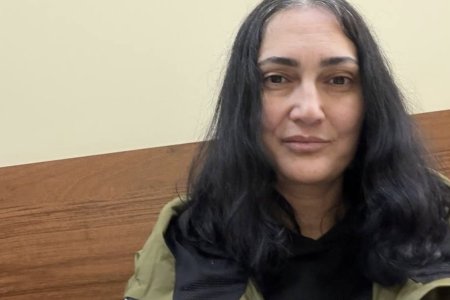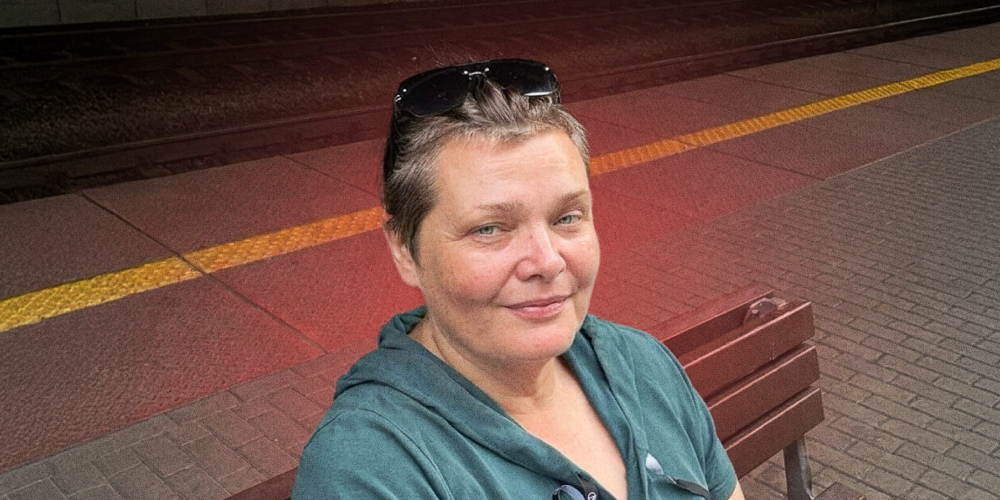
Victoria Serhieieva disappeared almost a year ago after landing at Sochi Airport, yet news of her whereabouts and of the treason charges concocted after six months have only now come to light. There are no grounds for doubting the account that the 55-year-old Ukrainian from Crimea has managed to give the First Department [Pyerviy Otdel] Human Rights Initiative , as Russia’s FSB has already used almost identical methods against several other Ukrainian nationals. The only difference this time is that Serhieieva denies making the donations to Ukraine’s Armed Forces and charities that Russia is cynically citing as supposed grounds for ‘treason’ charges and a possible sentence of up to 20 years’ imprisonment.
Serhieieva was ‘detained’ on 21 August 2025 when her plane from Istanbul landed at Sochi Airport. She was not on any wanted list and this was, in any case, more akin to an abduction, than to an arrest, with Victoria’s children long unable to find out even her whereabouts.
The Russian border guards clearly understood that Serhieieva is Ukrainian and demanded to see her Ukrainian passport. They scrutinized all the stamps in it and saw that she had spent almost the entire summer in mainland Ukraine. Despite there being nothing illegal about this, the border guards clearly questioned it and then brought in the FSB.
Her mobile telephone was taken away almost immediately and, illegally, checked without her being present. They demanded to know the passwords from her Ukrainian banking apps and, when she refused, shouted and threatened her until she gave them.
A little later they showed her bank transfers in hryvnia which she had supposedly made to support Ukraine’s Armed Forces as well as to some Ukrainian civic funds. She asserts that she never made such transfers and says that she had virtually not used Ukrainian bank services since 2021 and had left the phone which was linked to the account in mainland Ukraine.
In all those political trials of Ukrainians where information is available, no amount of proof that the ‘evidence’ was fabricated has made any difference, with it clear that convictions are essentially predetermined. On the other hand, the FSB clearly prefer to have ‘good paperwork’ and use torture, psychological pressure and / or threats to obtain ‘confessions’. In this case, the officers repeatedly drew attention to photos of Serhieieva’s children’s passports and hinted that they too could face ‘problems’. She recalls that she was beside herself with anxiety and signed the document with her supposed ‘confession’ that they thrust in front of her. She did so, however, after promises that everything would end with a fine and that she would be able to return home.
The FSB, as always, lied. She was instead arrested, although initially in a series of ‘carousel arrests’ on administrative charges. She was initially jailed for 13 days for having, purportedly, not shown her passport, then for a further 15 days on a charge of not obeying the police. There appear to have been four such terms of administrative arrest, with the FSB and police appearing with a new protocol of charges as she was due to be leaving the place of imprisonment. In all these cases, it is impossible that the ‘judges’ who passed the terms of imprisonment were not aware of the farce which they were abetting.
Serhieieva’s requests both to see a lawyer and to contact her children were rejected. She recalls also that, during one of these terms of imprisonment, she was given food and her medication only when she agreed to sign the protocol they put in front of her.
Judging by Serhieieva’s account, she is far from the only victim. In the Sochi SIZO where she was held, there were other women who were also seized over donations to Ukraine’s Armed Forces, contact with Ukrainians or claims of “links with the Ukrainian Armed Forces.” The women spoke of fellow prisoners having disappeared after visits from FSB officers.
Serhieieva was told at the end of September 2025 that “Moscow has agreed your prosecution on treason charges” and that she was to be moved to the Voronezh oblast. This, she was told, was because the ‘investigators’ work there, however the real reason was likely very different. She was taken to the notorious Borisoglebsk SIZO [remand prison] where Ukrainian prisoners of war have been systematically tortured and where, Pyerviy Otdel writes, “they torture women”.
At the entrance to Borisoglebsk SIZO, Serhieieva was ordered to lower her head, look only down at the ground and keep her hands behind her back. One of the officers told her that “you’ll stay in that position for many long years”.
She and the other women, who had not been convicted of any crime, were constantly insulted, shouted out, forced to stand and listen to or sing the Russian national anthem both morning and evening. During inspections of their cells, the women had to stand, with their face to the wall, their legs spread out and arms raised. After their shower, they were forced to stand, stretched out, for 10-15 minutes, read ‘patriotic verse’ and ‘thank’ the guards for their wash. Serhieieva also asserts that, during medical examinations, the women were forced to undress in front of men in masks who commented on their bodies and laughed at them. She herself was beaten once, after she complained of pain in her knees. On another occasion they threatened to use electric shocks against her.
According to Serhieieva, none of the women had been officially charged when brought to the SIZO. They were not allowed to contact their families, nor were they given access to lawyers. She herself was held in total isolation for almost five months. Pyerviy Otdel assumes that she was held in captivity on the basis of Russian leader Vladimir Putin’s ‘decision’ signed on 8 March 2022, two weeks after Russia launched its full-scale invasion of Ukraine. The ‘decision’, in flagrant violation of Russia’s own constitution and its commitments under international law, allowed the FSB and other enforcement bodies to hold people prisoner without any court ruling for opposing what Russia calls its ‘special military operation’ [i.e. war of aggression against Ukraine] More details here.
It was only on 28 January 2026 that Serhieieva (whose ‘investigators’ had purportedly been in Voronezh oblast) was taken to Krasnodar and officially informed of charges under Article 275 of Russia’s criminal code [‘state treason’]. She has retracted the supposed ‘confessions’ which she gave under threats to her children and constant fear.
There has been a massive increase in ‘treason’ prosecutions since Russia began its full-scaled invasion, with Ukrainians living on occupied territory first forced to take Russian citizenship and then cynically accused of ‘treason’ for supporting Ukraine. There have been no acquittals and the ‘trials’ are held behind closed doors, making it impossible to find out anything other than the propaganda version put out by the FSB and Russian state media.
Russia has abducted a very large number of Crimeans whose whereabouts are unknown, but who are believed to be accused of ‘treason’. On all occupied territory, Russia has sentenced a horrific number of Ukrainians, including some in their seventies to up to 17 years for donations to Ukraine’s defenders.
There are slightly fewer, but still many, cases similar to the abduction, carousel administrative detentions and charges of ‘spying’ or ‘treason’ against Ukrainian citizens seized by Russian border guards.
See:
Diana Havryliuk
https://khpg.org/en/1608815686
Oleksandr Kachkurkin
Young Crimean deported from Kazakhstan to face huge sentence in Russia for donating money to Ukraine
Kyrylo Kostyhov
and many others