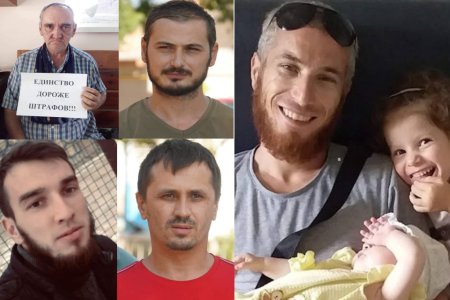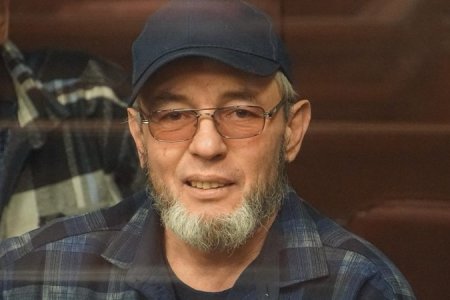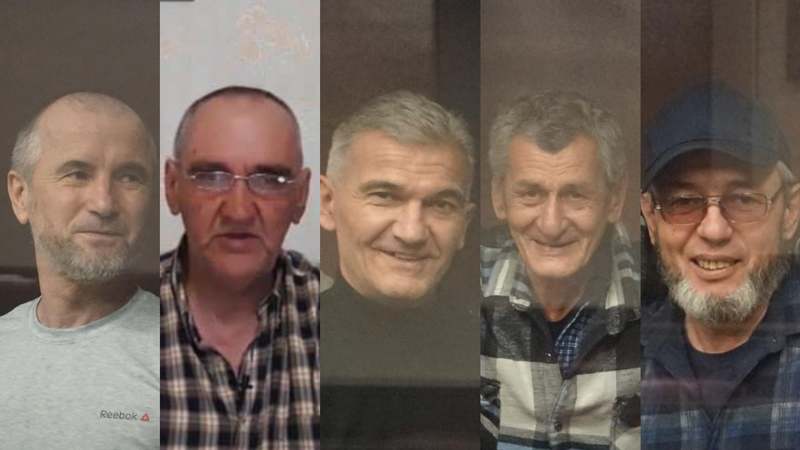
Russia’s Southern District Military Court on 21 May 2026 abruptly announced sentences from 14 to 20 years against five Crimean Tatar political prisoners from Dzhankoi. The sentences were passed just hours after the state prosecutor had demanded only slightly longer terms, with the five defendants therefore deprived of their right to a full court debate and final address. The haste was probably to avoid publicity for the death sentence that presiding ‘judge’ Sergei Obraztsov and his colleagues can have been in no doubt they were passing against 63-year-old Remzi Kurtnezirov, He is so gravely unwell that he has been held under house arrest, not detention, yet the court’ went along with grotesque charges against a man not accused of any recognizable crime and handed down a 20-year sentence in the harshest of Russia’s penal institutions. The 14 and 15-year sentences against Nariman Ametov; Enver Khalilayev; Ali Mamutov and Vokhid Mustafayev who are all in their fifties are no less flawed.
Russian prosecutor Pyotr Karandashev had, earlier on 21 May, demanded sentences of 17-18 years against the four other political prisoners and 21 years against Remzi Kurtnezirov. These were already alarmingly higher than the sentences passed up till now, despite all of these ‘trials’ being essentially identical. There should have been at least one more hearing so that the men and their lawyers could address the court. Instead, presiding ‘judge’ Sergei Viacheslavovich Obraztsov, Igor Vladimirovich Kostin and Alexei Borisovich Sannikov effectively confirmed that all such proceedings are only for show and simply announced the sentences.
Remzi Kurtnezirov was charged with ‘organizing a terrorist group’, under Article 205.5 § 1 of Russia’s criminal code, while the other four men were accused of ‘involvement’ in the alleged ‘terrorist group’, under Article 205.5 § 2. All five men were also accused of ‘planning a violent uprising’ (Article 278). While the charges can sound serious, they are based solely on a flawed Russian supreme court ruling from February 2003 which declared the peaceful transnational Hizb ut-Tahrir Muslim organization a ‘terrorist organization’. Hizb ut-Tahrir is legal in Ukraine; is not known to have committed acts of terror anywhere in the world; and does not fit the definition of terrorism in the relevant law passed in Russia in 2006. All of this is ignored, with Russia’s FSB in occupied Crimea actively using the supreme court ruling, together with fabricated ‘evidence’ of involvement, as a weapon against the Crimean Tatar human rights movement and against Muslim communities seen as too independent of the Moscow-loyal Directorate of Muslims of Crimea.
Although the state-controlled propaganda media invariably parrot the FSB’s claims to have “broken up a terrorist cell”, the truth is much more sordid. Despite supposed ‘terrorism’ charges, the armed enforcement officers who burst into the men’s homes early in the morning never even pretend to be looking for weapons, explosives or other evidence of violent intentions. They concentrate solely on so-called ‘prohibited religious literature’ which, in this case and most, the FSB bring with them and then claim to have found. The only other evidence comes from illicitly taped conversations, often in a mosque, which get sent to FSB-loyal academics who give supposed ‘assessments, and from ‘secret witnesses’. In this case, the anonymous ‘witness’ claimed to have been a member of Hizb ut-Tahrir and to have visited the village cited in the indictment. He could not, however, name the memorable place in this village and was unable to provide other information that he should have had were he telling the truth. In addition, one of the defence lawyers told Crimean Solidarity that this individual spoke in a manner very typical of enforcement officers. All such flaws in the evidence are ignored by the court, with the presiding judge in such trials typically blocking questions aimed at demonstrating that the person is lying.
The court then provides the sentences clearly expected of it, with this only confirmed by the fact that the terms of imprisonment seem to be getting longer and longer. We are not dealing here with inflation making prices go up, but with political decisions to increase the already massive sentences.
All of these sentences are for maximum-security penal institutions, with prisons having the harshest conditions, but prison colonies also very bad, and generally thousands of kilometres away from Crimea and the men’s families.
Remzi Kurtnezirov (b. 17.09.1962) was sentenced to 20 years’ maximum-security imprisonment, with the first four years in a prison
Nariman Ametov (b. 04.10.1970) was sentenced to 15 years with the first two in a prison;
Enver Khalilayev (b. 13.02.1967) – 14.5 years, with the first two in a prison;
Ali Mamutov (b. 10.04.1976) - 14 years with the first two in a prison;
Vokhid Mustafayev (b. 25.01.1976) – 14 years with the first two in a prison.
Appeals will be lodged, with Remzi Kurtnezirov remaining under house arrest until after the appeal hearing. It has become tragically clear over the last year that Russia is willing to ignore its own regulations on illnesses precluding imprisonment when it comes to Crimean Tatar and other Ukrainian political prisoners. If men in dangerously poor health are not immediately taken into custody, this is, brutally speaking, to ensure that the political prisoners do not die before the FSB and prosecution “get their convictions”. It is frustrating that ‘judges’ like Sergei Obraztsov; Igor Kostin and Alexei Sannikov are also willing not only to play their role in such flawed trials, but also to pass a 20-year sentence against a 63-year-old who has already had three strokes and cannot move one side of his face and body; has permanent invalid status, high blood pressure, sugar diabetes and more. It was because of his dangerously poor health that he was forced to give up his position as Imam in the community mosque.
Six Crimean Tatars from Dzhankoi or its surroundings were arrested on 5 March 2024, with most likely targeted as members of independent Muslim communities. The sixth man - Arsen Kashka (b. 1984) also attended political trials, took part in flash-mobs in solidarity with political prisoners, as well as supporting their families. His ‘case’ was, for some reason, removed for separate proceedings.