The European Court of Human Rights [ECHR] has found that Russia violated the rights of 12 Crimean Tatars who were detained and subsequently prosecuted for a peaceful picket in Moscow in defence of four Crimean Tatar political prisoners. 52 Crimean Tatars were arrested on 10 and 11 July 2019, and analogous rulings on the other 40 applicants seem likely in the near future.
The ECHR ruling in the Case of Abdullayev and Others v. Russia was passed on 30 April 2026. It has been received by the lawyers but has yet to be published on the HUDOC website. Although Russia withdrew from the European Convention on Human Rights and, therefore, ECHR, in 2022, the applicants’ arrests and prosecutions took place in 2019, and the Court was in no doubt that they fell within its jurisdiction. There should equally be no doubt that Russia is obliged to comply by the ruling and, at very least, pay the applicants’ the four thousand euros each, which the Court awarded. Unfortunately, lawyer Elvina Semedlyaeva is almost certainly correct in calling Russia’s compliance with the ruling “problematical”, while stressing that the ruling has both legal and political significance. Knowing that Russia will not comply must not mean that such compliance is demanded, and Russia’s violations fully recorded.
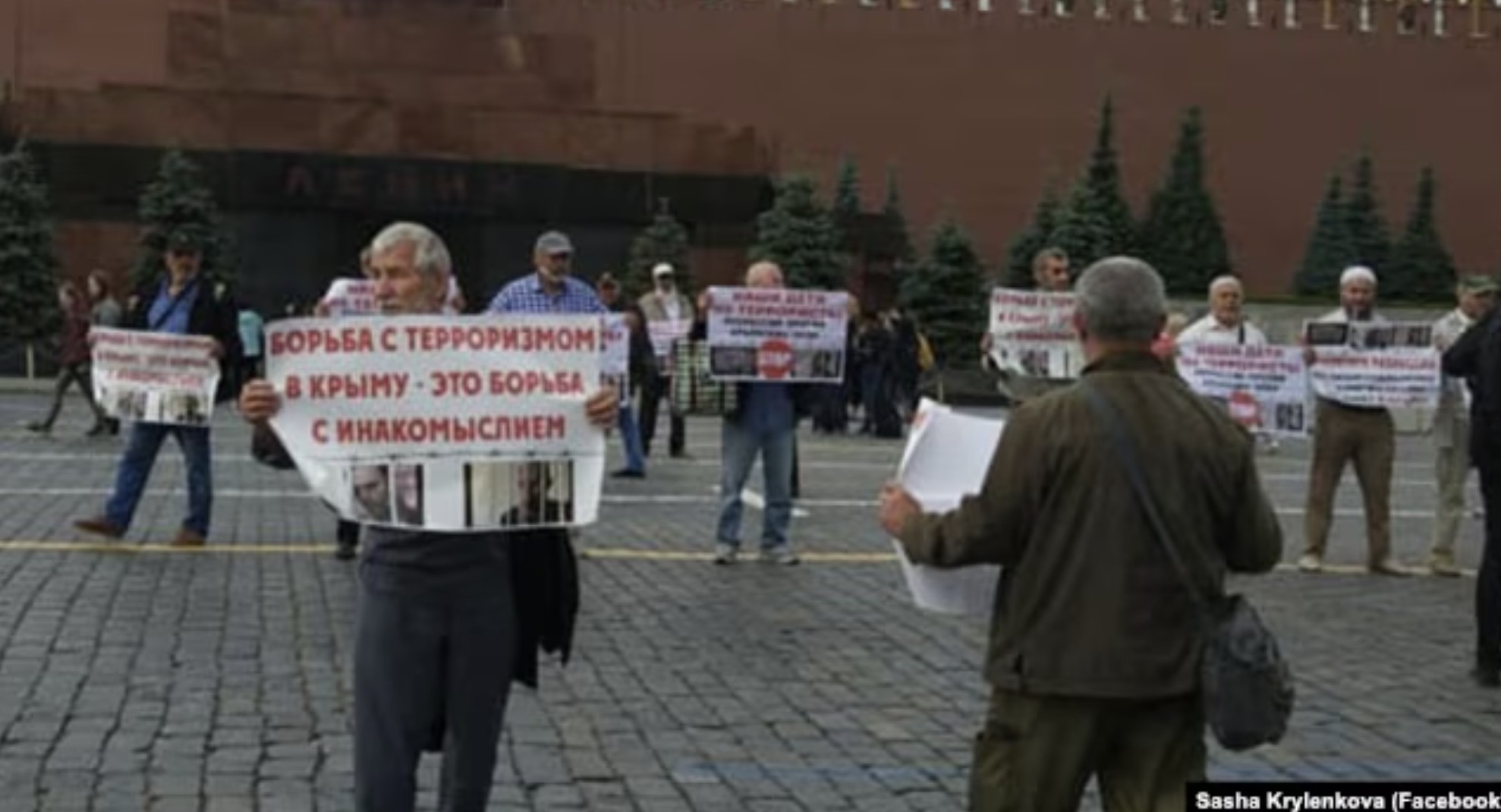
Although the ruling mentions only the Russian treatment of peaceful protesters on 11 July 2019, the arrests began the day before. As reported, on 10 July 2019, around twenty Crimean Tatars, many of them veterans of the Crimean Tatar national movement gathered in a line along Red Square with placards reading: “Our children are not terrorists”; “The fight against terrorism in Crimea is a fight against dissidents” and “Stop persecution on ethnic and religious lines in Crimea”. The entirely peaceful picket was in advance of the appeal hearing on 11 July against horrific sentences passed on four recognized Crimean Tatar political prisoners (the ‘First Bakhchysarai Group’). Seven men were detained that day and charged under Article 20.2 of Russia’s code of administrative offences with supposed ‘infringement of the established procedure for holding a meeting’. Such allegedly “established procedure” runs counter to Russia’s own constitution since it involves asking for permission which is almost never granted.
On 11 July, around 50 Crimean Tatar activists were detained as they stood peacefully outside Russia’s supreme court, in solidarity with the four political prisoners whose appeals were rejected that day.
The Court, in its ruling, agreed that Russia was in violation of Article 11 of the European Convention on Human Rights (Freedom of Assembly) through the men’s arrest and subsequent conviction for administrative offences.
It is hardly possible to view violations of Article 11 in isolation, when they are usually combined with unwarranted arrests and essentially predetermined convictions. The applicants had, therefore, also complained of violations of Article 5 through their unlawful detention and their right to a fair trial, under Article 6. The Court concluded that there had been violation of the Convention with respect to other complaints in accordance with ECHR established case law.
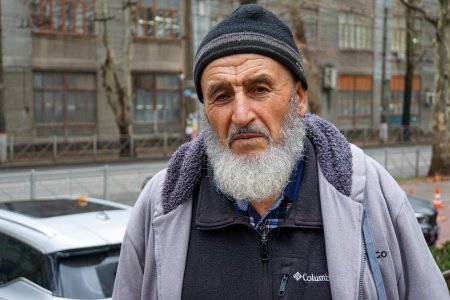
It should be stressed that the Crimean Tatars who travelled to Moscow to peacefully demonstrate their solidarity and protest against Russia’s mounting repression in occupied Crimea knew that they were in danger of prosecution themselves. Nor did such danger lie only in administrative prosecutions. Russia’s FSB later came for two of the men detained on 10 or 11 July 2019. Azamat Eyupov (b. 1963) is serving a 17-year sentence on identical charges to those against the four political prisoners he was defending, while Ametkhan Umerov (b. 1986) is facing a similar sentence on the same flawed charges. The same is true of a huge number of Crimean Solidarity civic journalists and activists who are initially detained and arrested on administrative charges. Then, when they refused to be cowered into silence, the FSB fabricate their grotesque ‘terrorism’ charges.
‘The ‘First Bakhchysarai Case’
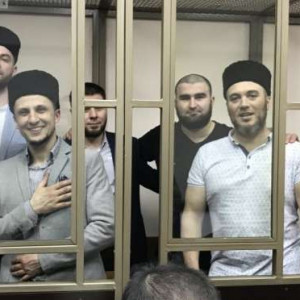
Four respected members of the community in Bakhchysarai were arrested on 12 May 2016, with Enver Mamutov (b. 1975) still imprisoned, and the three other Crimean Tatars: Rustem Abiltarov; Zevri Abseitov and Remzi Memetov only freed after serving their sentences to the last day. Although not one of the men was accused of having committed or even planned to commit an actual crime, the FSB organized a huge ‘operation’ that day, blocking roads and staging armed and masked searches of the men’s homes.
The masked men taking 49-year-old Remzi Memetov away were asked by one elderly woman what right they had. “Our people have never caused anybody harm, never! We lived so many years in Ukraine, there was not one terrorist act, no harm…. You have no right to carry out such searches…”
The men were charged with entirely unproven ‘involvement’ in the peaceful transnational Hizb ut-Tahrir organization which is legal in Ukraine. In a suspiciously secretive hearing in February 2003, Russia’s supreme court declared the organization ‘terrorist’. That flawed and never explained ruling has been used since 2014 to impose monstrous sentences for alleged ‘involvement’ in an organization which is not known to have committed any act of terrorism anywhere in the world.
These are widely acknowledged to be conveyor belt prosecutions in which one man, in this case, Mamutov, was designated the more serious charge of ‘organizing a Hizb ut-Tahrir’ group (under Article 205.5 § 1 of Russia’s criminal code), while the others were accused merely of involvement in that group (Article 205.5 § 2). Long after the men’s arrest, new charges were brought against them, and others in analogous cases. Four practising Muslims and fathers of at least two children were accused of having been planning to violently seize power (Article 278).
All of these cases are based on flawed ‘expert assessments’ given by FSB-loyal academics and the testimony of ‘secret witnesses’, who can repeat the indictment verbatim but “don’t know” or “don’t remember” the answers to basic questions about the defendants whom they claim to have known well.
Despite the overwhelming evidence that there were no grounds for the charges, on 24 December 2018, three ‘judges’ from the Southern District Military Court - Roman Konstaninovich Plisko (presiding), Anatoly Vladislavovich Kolesnik and Igor Vladimirovich Kostin essentially did as they were told and found all four men ‘guilty’ of the charges. Mamutov was sentenced to 17 years’ maximum-security imprisonment; Abiltarov; Abseitov and Memetov were sentenced to 9 years. The appeals against the sentences were rejected on 11 July 2019, with the supreme court merely reducing each sentence by 3 months.
Enver Mamutov’s final address to the first court included the following:
“However much you persecute me, my people and Muslims in general, we spoke and will continue to speak the truth”.
“What is happening today in relation to me and to all the Crimean Tatar people, to Crimean Muslims, is politically motivated persecution for dissidence. Before the pretext of enemies of the people was used to fight dissident views, now they claim it to be about fighting terrorism and extremism. However both then and now, the charges are based on blackmail, on pseudo-experts, and fake witnesses, on fiddling the facts and distorting what people say. I would like to wish that my people and all Muslims continue their peaceful resistance to pressure and persecution, and uphold the interests of their compatriots.”