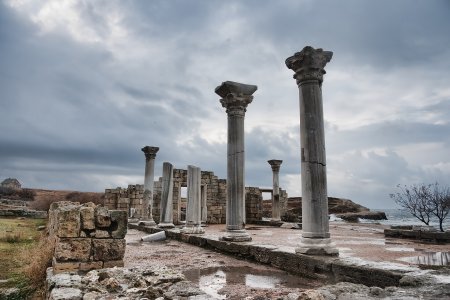
UNESCO has added Tauric Chersonese in occupied Crimea to the UNESCO List of World Heritage in Danger due to Russia’s illegal excavations and plundering of this ancient site, and its ‘construction work’ to the site and its buffer zones. The move is important and very welcome, if belated. Russia has been endangering sites of Ukrainian cultural heritage in occupied Crimea since 2014, with the damage to the Ancient City of Tauric Chersonese and its Chora, the Crimean Tatar Khan’s Palace, or Hansaray in Bakhchysarai and other sites very likely irreparable.
The decision to place Tauric Chersonese on the UNESCO List of World Heritage in Danger was taken on 23 July 2026 at the 48th session of the UNESCO World Heritage Committee in Busan (South Korea). This brings to four the number of Ukrainian World Heritage Sites on the list with all in danger because of Russia. The Saint-Sophia Cathedral and Related Monastic Buildings, Kyiv-Pechersk Lavra in Kyiv; L'viv – the Ensemble of the Historic Centre ; and The Historic Centre of Odesa were all added to the list in 2023 because of the very real danger from Russian missile and drone attacks.
In reporting the move by the UNESCO World Heritage Committee to inscribe Tauric Chersonese and its Chora on the list, Andriy Sybiha, Ukraine’s Foreign Minister, noted that the decision also calls upon the international community to strengthen cooperation in preventing the illicit trafficking of cultural property from occupied Crimea. The Committee also called for protection of the Khan’s Palace in Bakhchysarai; the cave towns of the Crimean Gothia; the Crimean Astrophysical Observatory and the Sudak Fortress.
The decision confirms the danger which all sites of cultural heritage face under Russian occupation.
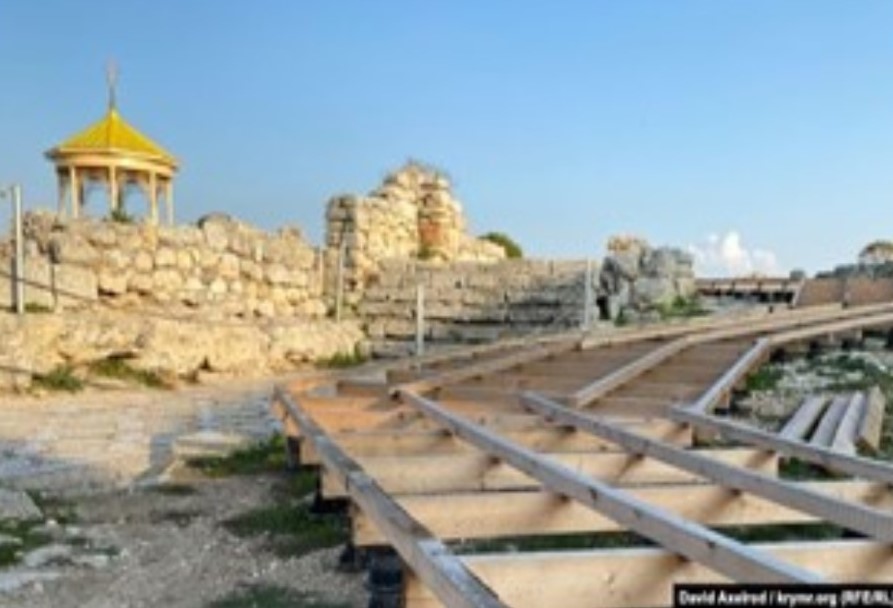
The first warnings about Russia’s dangerous construction plans at Tauric Chersonese were publicly articulated in 2019, with the fears expressed then having proven to be fully justified. By 2024, Russia had even built something it called a ‘historical-archaeological park’ on territory directly linked with Tauric Chersonese. One of the aims from the outset seems to have been to ‘rewrite history’ and claim historical links to the site and to Crimea that Russia does not have. The damage caused was barbaric with heavy bulldozers used on an archaeological site with a cultural layer of up to 10 metres. The resulting ‘New Chersonese’ was a glossy, anachronistic fake, with fountains, lawns, Chinese bridges and a domed temple. This was a project personally overseen by Putin and the former KGB agent’s so-called Russian Orthodox Church ‘confessor’, Tikhon Shevkunov, with the Russian Orthodox Church’s ‘My History’ Foundation officially managing the project.
It was in 2024 that Ukraine began preparing the documents needed to ensure that Tauric Chersonese was placed on the List of World Heritage in Danger. Its report, presented to the 48th Session speaks of irreversible damage to the archaeological site’s integrity and authenticity due to Russia’s “extensive unauthorized excavations, large-scale construction projects, and removal of artefacts. Notably, the site has been transformed into a so-called “historical and archaeological park” (branded “New Chersonese”) featuring new buildings (museums and religious structures) and even an open-air theatre built over ancient ruins. Tens of thousands of archaeological finds have reportedly been illicitly removed from the property and transported out of Crimea or lost to uncontrolled disposal, raising alarms about looting.” Further details can be found in Ukraine’s State of Conservation Report on Tauric Chersonese.
While neither UNESCO, nor really any other UN bodies, have effective mechanisms for forcing Russia to comply with international law, the public recognition of the damage it is causing to a site not only of Ukraine’s, but of World Heritage, is of enormous significance.
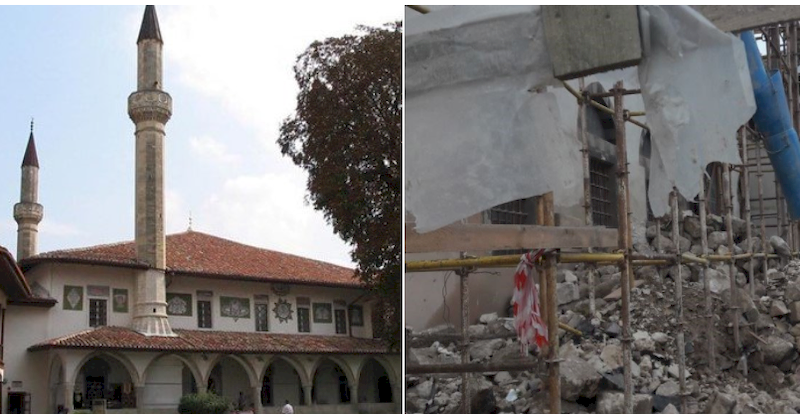
The situation with the Khan’s Palace, or Hansaray, in Bakhchysarai is even more tragic. This very beautiful complex, where some of the buildings date back to the 16th Century, is of huge historical and cultural significance for the Crimean Tatar people and for Ukraine. The complex was built as the main residence of the monarchs of the Crimean Khanate - the state of the Crimean Tatar people – and was the political, religious and cultural centre of the Crimean Tatar community until the first Russian occupation and collapse of the Khanate in 1783. It was placed on UNESCO’s World Heritage Tentative List back in 2003, but the necessary work for establishing its international status was unfortunately not completed. By January 2018, it had become clear that the barbaric pretence at ‘restoration’ of the complex was gravely threatening its authenticity and making full UNESCO World Heritage Site recognition effectively impossible.
The word ‘barbaric’ is no exaggeration. How else could you describe stripping the Khan’s Palace of the original, hand-made, tiles, most of which needed, at most, a clean, and replacing them by factory-produced ‘old-style’ Spanish tiles? There was also the supposed ‘excavation’ work around the Big Khan Mosque, the Khan Cemetery and the Stables, carried out by construction workers, rather than restorers. Video footage quietly obtained at the time made it clear that the worker videoed was simply dumping artefacts, including tiles of immense historical significance, in a pile with no attempt to photograph them and ensure their preservation. The construction workers let loose on the complex totally destroyed the historic wall fresco on the Khan’s Palace. They had, supposedly, “thought that it was simply old plaster work.”
Heavy construction equipment, such as hydraulic drills, had been used for dismantling work, with this causing vibration and the loss of part of the wall’s finish. The list goes on.
While corruption undoubtedly played a role, it does seem likely, as Elmira Ablyalimova, former Director of the Bakhchysarai Historical Cultural Reserve, has suggested, that such a level of incompetent barbarism is no accident. Russia is deliberately destroying a crucial monument for Crimean Tatars, one that clashes with the ‘Russian world’ ideology that Russia is using to justify its invasion and ongoing occupation of Crimea.
Ablyalimova noted that Russia uses historical monuments, museums, etc. if they can be fitted into their ideological narrative, as political tools. They claim that Crimea was ‘always Russian’ and that ethnic Ukrainians are “the same people” as Russia in order to then try to appropriate such ancient monuments as Chersonese as ‘Russian’ Moscow’s cultural imperialism, however, has problem with the Crimean Tatar people. It therefore concentrates on them being different, “enemies whose history should be ignored or rewritten, doing everything to destroy evidence of the people’s existence, memory of their existence.” This is not done openly, of course, but that is effectively what the supposed ‘restoration’ of Khan’s Palace is achieving.
Russia totally destroys Chersonese UNESCO site in grotesque attempt to justify Crimean occupation