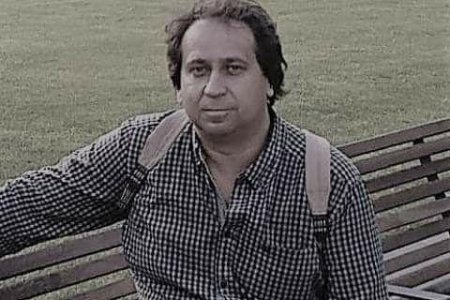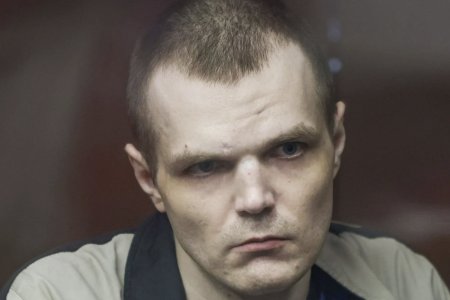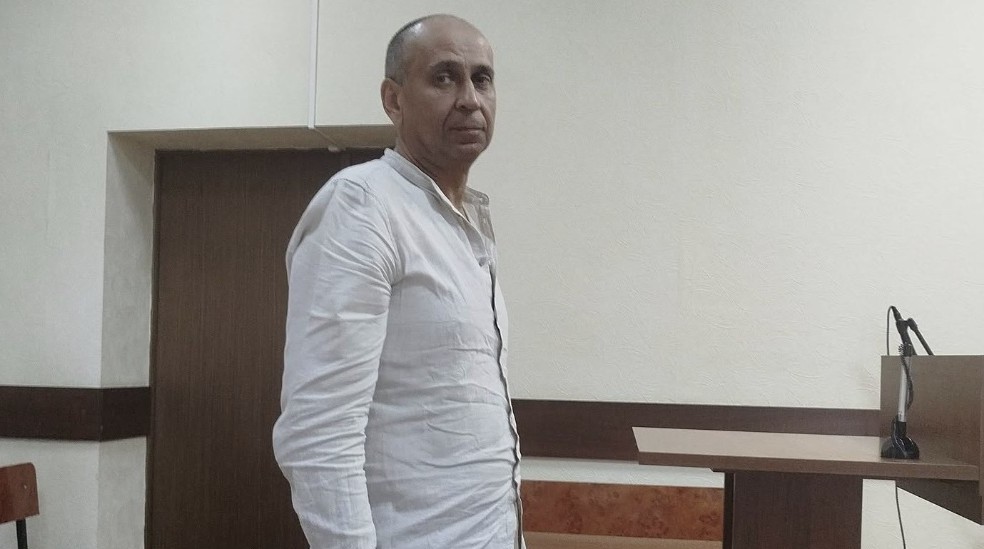
Serhiy Buhaichuk ((b. 21 May 1975)) was fined by a Russian court this week on an absurd administrative charge fabricated by the men who warned him as he ended a politically motivated 8-year sentence that he would not get away “so easily”. He may now be facing a new ‘trial’ and possible 4-year sentence with his captors using the same preposterous charge of ‘demonstrating an extremist symbol’ and faked evidence, just claiming that he did it more than once.
Even without knowing the circumstances around Buhaichuk’s ‘release’ from Prison Colony No. 1 in Tula oblast on 10 July 2026, the new administrative ‘trial’ before the Donskoy court would have aroused serious doubts. Former Russian political prisoner Olga Bendas described the first hearing into the charge of ‘having publicly demonstrated an extremist symbol’ (under Article 20.3 of Russia’s ‘code of administrative offences’). The charge was over a Ukrainian flag which was planted in Buhaichuk’s belongings while he was held in a punishment cell for the last ten days of his sentence. The men in plain clothes who accosted him on 10 July as he tried to leave the prison colony carried out a ‘search’ of his belongings. They not only claimed to have ‘found’ the flag which Buhaichuk would have had no opportunity of obtaining and possessing but openly wrote the word “Azov” on the flag in front of him with a marker pen. It is not, in fact, clear how they attempted to justify the claim about ‘an extremist symbol’. It is quite a step to call a country’s flag ‘extremist’, but there were such attempts to justify bans on peaceful gatherings in occupied Crimea back in 2015. Russia has tried to claim that both the symbol of the Ukrainian Armed Forces' Azov Regiment and the Ukrainian Tryzub [the trident which is Ukraine’s coat of arms] are ‘prohibited symbols’. Under any circumstances, the charge would be preposterous. It is also denied by Buhaichuk and his application for the relevant biological and chemical tests for DNA to be carried out was entirely legitimate. It was rejected by the court, as was his equally justified application for CCTV footage to be presented. The next hearing was scheduled for 24 July, with the prosecution to produce three supposed ‘witnesses’ who claimed to have been present when Buhaichuk “demonstrated an extremist symbol”.
Such ‘witnesses’ must be other prisoners who can very easily be pressured, threatened or effectively bribed (through promises of better conditions, for example) into providing such ‘testimony’. Bendas wrote then that they were continuing their torment of Serhiy Buhaichuk and threatening that, if he denied the charges and did not ‘repent’, they would make things worse for him.
On 29 July, the Donskoy court found Buhaichuk guilty of demonstrating ‘an extremist symbol’ and fined him two thousand roubles. While this may be a small fine, the Memorial Support for Political Prisoners Project warns that Buhaichuk now faces the threat of criminal charges under the article on ‘repeated demonstration of a prohibited symbol’ (Article 282.4 of Russia’s criminal code, with this carrying a sentence of up to four years’ imprisonment.
If you can get supposed ‘witnesses’ to state that Buhaichuk showed them ‘an extremist symbol’ once, in order to secure an administrative prosecution, why not get them to say that he did it more than once?
Russia is for the second time using other prisoners to fabricate charges and lengthen its reprisal sentence against 67-year-old Oleh Prykhodko for his pro-Ukrainian position and opposition to Russia’s occupation of his native Crimea. It used equally flawed charges and ‘evidence’ to sentence Hennadiy Lymeshko to a further two years’ maximum-security imprisonment after he served his politically motivated 8-year sentence to the last day. Olga Bendas has initiated a collection to ensure that Serhiy Buhaichuk is properly represented. Publicity can also, hopefully, help as the charges really are insanely implausible.
It is thanks to Olga Bendas that we know about these events. She was waiting outside the prison colony on 10 July 2026 to pick up Serhiy on his (scheduled) release and was able to report that, instead three men in plain clothes had dragged Buhaichuk, who was handcuffed to one of them, out and pushed him into a car. He had seen Olga and called out for her to help, saying that he was being tortured, that they had planted a Ukrainian flag on him and were fabricating a new prosecution. He later managed to contact her from the Centre for holding foreign citizens pending deportation where he had been taken and explained how a pretext had been found for placing him in a punishment cell for the final ten days of his sentence, with the time used to plant the Ukrainian flag. The addition of ‘Azov’ is particularly menacing given Russia’s use of a politically motivated supreme court ruling from 2 August 2022 declaring this unit of Ukraine’s Armed Forces ‘a terrorist organization’ as pretext for a huge number of ‘trials’ against Ukrainian prisoners of war and civilian hostages.
Despite being beaten by the men in plain clothes, Buhaichuk refused to sign the protocol claiming that the flag had been ‘found’ in his personal belongings.
As reported, there have been occasions since 2014 where people really did appear to have been targeted for Russian prosecution merely because they were Ukrainian. This was the case with the arrests, first in May 2018 of Ukrainian coach driver Oleh Chaban, and then, on 11 July 2018, of Serhiy Buhaichuk, a train conductor from Rivne in Western Ukraine. It was through the lawyer representing Ukrainian journalist and political prisoner Roman Sushchenko that it was learned that another Ukrainian was being held in the FSB-controlled Lefortovo Prison in Moscow. He had been charged with ‘smuggling’ a Glok 19 pistol and parts for it to Moscow (another report mentions the pistol but asserts that there were also 10 barrels for a Makarov pistol). He was alleged to have done this as part of a gang of three people. Nothing was found during the search of Buhaichuk and his possessions, and the charges were based solely on the ‘testimony’ of a Russian detained much earlier and held in a SIZO [a pre-trial detention centre]. The latter ‘cooperated’ with the investigators, almost certainly either under pressure, or through promises of a reduction in the charges against him. There was supposed to be a third person in the alleged ‘gang’, a person called ‘Vladimir’ whose identity (or existence) remained a mystery.
The case was run by the FSB, with Buhaichuk charged under Article 222 § 3 of Russia’s criminal code - Illegal acquisition, transfer, sale, storage, transportation, or bearing of firearms or their components, if carried out by an organized group. Buhaichuk consistently denied the charges and said that he had ‘confessed’ under duress, while held incommunicado, without any contact with an independent lawyer.
Despite the lack of any evidence, except the testimony of one man already in detention and with a likely vested interest in ‘cooperating’ with the FSB, Buhaichuk was sentenced on 12 February 2020 by a court in Bryansk to nine and a half years’ imprisonment – longer than the 5-8 years envisaged by Russia’s criminal code. The appeal court on 9 June 2020 merely reduced the sentence to eight years.
Serhiy Buhaichuk, whose adult daughter’s first child was born soon after her father’s arrest and whose 11-year-old son grew to adulthood without his father, served that deeply flawed sentence to the last day, and even that proved to not satisfy his Russian captors.