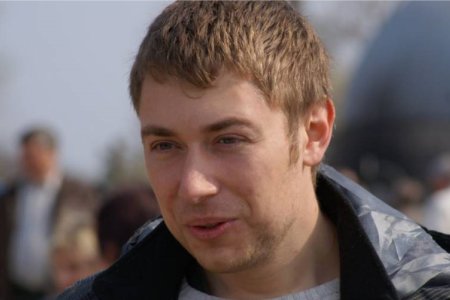
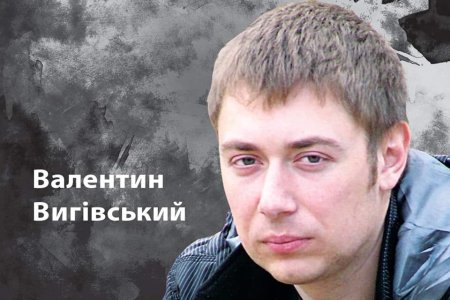
Valentyn Vyhivsky’s son had not yet begun school when his father was abducted by the Russian FSB. Over 12 years later, he is in his first year at university and Valentyn is still held prisoner in Russia, even though his politically motivated 11-uear sentence ended a year ago. In an interview, via an Internet messenger, to the Media Initiative for Human Rights [MIHR], Valentyn Vyhivsky spoke of his abduction, torture and imprisonment in Russia. Much of the story has been reported here over the years, but there are important new details shedding light on how he likely came to be targeted by the Russian FSB, and about the horrific treatment he received. Valentyn Vyhivsky was not the first of Russia’s Ukrainian political prisoners, but he has now been held in Russia longer than any other and spent a monstrous 8 years in solitary confinement. It is vital that he is released and publicity can help, as could assistance from third countries since Russia is claiming that it cannot free him because of the war and lack of diplomatic and consular relations with Ukraine.
It was clear for a very long time that Vyhivsky had been tricked into travelling from Kyiv to already occupied Simferopol on 16 September 2014. He acknowledged himself in the interview that he had understood intuitively that he was making a mistake, but this was not the first time that his sympathy for another person, apparently in need, had let him down. As reported, Vyhivsky had been fascinated from childhood in aviation electronics and design, and spent a lot of time discussing new developments, etc, both with specialists and other enthusiasts, including via online forums. It was one of these enthusiasts who contacted him in the summer of 2014 and asked if he could lend her four thousand US dollars as her grandfather was very ill and needed treatment. She stipulated that they needed to meet in Crimea and, although this did seem odd, he, unfortunately, agreed. It was a trap, with the FSB lying in wait for Vyhivsky when he arrived on 16 September 2014 at Simferopol Railway Station. As soon as he saw the woman he had arranged to meet there, he was grabbed by men in masks who silently forced him to the ground and then dragged him into some room where they told him he was suspected of ‘spying’. He was interrogated for two hours there, then taken by plane to Moscow, with his captors beating him all the time. They also told him that the Russian ‘special operation’ to catch the supposed ‘spy’ had involved around 30 officers who flew in a work plane. The ‘special operation’, they told him, had cost 150 thousand USD.
It is worth noting that there was not only total secrecy about this supposed ‘special operation’ but also doubt about the actual charge that Vyhivsky was facing. It was only in October that Petro Vyhivsky learned that his son was imprisoned in Moscow, at Lefortovo Prison, and only some eight months after his abduction that Zoya Svetova, human rights activist and member of a Russian monitoring group, was able to see Vyhivsky. The initial charge was reported as under Article 183 of the Russian criminal code (illegally receiving and disclosing information constituting a commercial, tax or banking secret), and was only changed to ‘espionage’, under Article 276 several months later.
When, during his ‘interrogations’ at Lubyanka, the FSB headquarters, Vyhivsky refused to sign his supposed ‘confession’, he was sent by the ‘investigator’ to FSB officers who took him to a forest. There he again had a bag over his head, with the FSB men beating him, and also subjecting him to what he calls a form of psychological torture, with the men saying nothing, but constantly re-locking their machine guns, clearly hinting at what could await him if he continued refusing to ‘cooperate’.
He was then taken back to Lubyanka where the ‘investigator’ spelled out his ‘options’: “If you’re stubborn, you’ll get 18 years. Confess and it’ll be 11 years. whatever figure we write for the judge on the case, that’s the sentence you’ll get.”
Vyhivsky signed ‘the confession’. Even then, he was subjected to farcical ‘investigative experiments’ in Moscow, not Crimea, where the supposed ‘spying’ had taken place, during the year that it took the FSB to concoct the ‘case’ against him.
Vyhivsky was held in solitary isolation for eight years – with this in itself a form of torture. Trying to understand why the Russians had targeted him, he recalled an argument on one of the Internet forums which he now believes may have played a fatal role. The young Ukrainian had taken part in the Euromaidan protests and was appalled by Russia’s invasion and annexation of Crimea, and the military aggression in Donbas. He had ended up in a very heated argument with a Russian who was clearly hurling out the propaganda lines that Russia was pushing at that stage (and since) to justify its military aggression.
At the beginning of Russia’s war against Ukraine, the FSB either received instructions or simply wanted to hunt out ‘Ukrainian saboteurs’ or ‘spies’, and almost certainly received promotion or bonuses for such ‘vigilance’. Credibility was never an issue, as was seen also in Russia’s other ‘spying’ case against 73-year-old Yury Soloshenko.
Closer to the ‘court hearings’, Vyhivsky also received several visits from the FSB in which they offered freedom in exchange for collaboration with Russia. He understood that, even before his abduction, the FSB had hacked his computer and thought his knowledge of aviation engineering could be of use to Russia. He refused. He recalls that neither the FSB, nor the prosecutor during the ‘trial’, appeared able to understand that Ukraine is not a part of Russia, and that when they tell him he can serve his “родине” or motherland, for him this is Ukraine, not Russia.
Vyhivsky was sentenced by the Moscow regional court on 15 December 2015 to eleven years maximum-security imprisonment, with the ‘trial’ behind closed doors and with a state-appointed lawyer. In reporting the sentence, the FSB claimed that Vyhivsky had come to their attention in 2012 and was suspected of gathering information containing commercial secrets through bribes, as well as information containing state secrets in order to pass them to a representative of a foreign state.
It was only after the sentence that Vyhivsky was allowed access to an independent lawyer. The lawyer was, however, forced to sign a non-divulgence agreement or face criminal prosecution. The appeal which is likely to have detailed the torture used to obtain his ‘confession’ was, predictably, rejected by Russia’s Supreme Court on 31 March 2016.
Like his grandfather, who was a victim of Soviet repression, Vyhivsky was imprisoned in Kirov oblast. His grandfather was, however, released after Stalin’s death. Vyhivsky, in contrast, was held prisoner for the entire 11 years, with eight of those years in solitary confinement, and is still held in a detention centre.
In the interview, he called those eight years the worst experience of his life and noted that the conditions were essentially those of a Russian ‘punishment cell’, or SHIZO. There are limits, however, on how long a person is placed in a SHIZO (limits, admittedly that are regularly flouted in the case of Crimean Tatar and other Ukrainian political prisoners). It is hard to imagine how he survived eight years of such torture, when a day feels like a week. “Even now I have the feeling that I’m about 80”,
His move from solitary confinement more or less coincided with Russia’s full-scale invasion of Ukraine, and he swiftly ended up in a punishment cell, although only for a month, after other prisoners denounced his words of outrage over Russia’s actions. Back in 2022, his mother also reported that her son had been prevented even from corresponding with them.
Vyhivsky’s interview also provides still further confirmation of Russia’s totally horrific treatment of Ukrainian prisoners of war, especially those who defended Azovstal in Mariupol. They were brought to the prison colony in Kirov oblast in the summer and autumn of 2023 but kept in a separate part of the prison. He recalls that even the prison staff who treated him more or less OK, behaviour, behaved shockingly to the POWS. “I didn’t see that, but I heard it.”
Although they were not allowed near the POWs, Vyhivsky says that you could see how badly they were treated. They were beaten and received tiny portions of food which they were give just two minutes to eat. When Vyhivsky yelled at the prison guards for their behaviour and said they would one day be punished for it, the guards turned on him and threatened to treat him the same way if he didn’t shut up.
“Prison is a place where conditions can always get worse. You can think that you’ve reached the bottom, but then it turns out you haven’t.”
Freed yet still in captivity
Valentyn Vyhivsky should have been free to return to Ukraine on 17 September 2025. His passport by then had, however, expired, and there are no consular or diplomatic relations between Ukraine and Russia. He was taken to a detention centre for people awaiting deportation and has been there ever since, with Russian courts periodically rubberstamping this other form of captivity. The conditions are certainly better, yet he remains imprisoned, and all attempts by his father to pin down Ukrainian officials receive the same response – that they are working on it.
As reported, one of the problems is the lack of any mechanism in such cases, however this may not be the only obstruction. Petro Vyhivsky told MIHR that he had learned from various human rights organizations that there has been a directive from Aleksandr Bastrykin, head of Russia’s Investigative Committee, banning staff of prison institutions from allowing Ukrainian civilians to be handed over to the Ukrainian authorities if they are of conscription age. The directive was, supposedly, secret. If there was such a directive, it must have been fairly recent, as another political prisoner, Andriy Kolomiyets, who was only 22 when seized in 2015, was, finally, released from a detention centre and, eventually, able to return to Ukraine in July 2025.
In other cases, political prisoners, such as Hennadiy Lymeshko and Serhiy Buhaichuk, Dmytro Shtyblikov and 67-year-old Oleh Prykhodko have had new criminal charges fabricated, either when they were already due to leave prison or while still imprisoned.
Valentyn Vyhivsky and his family have endured too much already. Please help to publicize his case and, perhaps, contact the foreign ministry of your country. While other countries would need some kind of document before admitting a person, they could surely cooperate on this with Ukraine and intervene on Valentyn’s behalf.