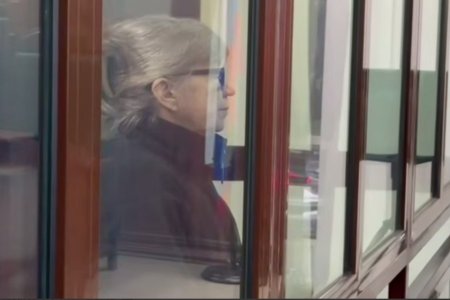
Olha Baranevska (b. 1963) had spent her life working with children but refused to return to her job as a preschool teacher after Russia’s invasion and occupation of Melitopol (Zaporizhzhia oblast) in 2022. Her daughter, Aksinia, is convinced that it was Olha’s unwillingness to betray her country and collaborate with the invaders that led to her being abducted in May 2024. She remains imprisoned to this day.
Aksinia and her son left Melitopol after the invasion, however her mother stayed behind in order to care for her elderly parents, later for her widowed mother. She resisted pressure to return to teaching work, living quietly, ensuring that her mother had everything she needed and growing the flowers that were her passion. She did not conceal her pro-Ukrainian position and was in no hurry to take the Russian passports that the invaders have very aggressively foisted on Ukrainians living on occupied territory. She maintained contact with her family in free Ukraine, transferred money to them and also, apparently sent donations. All of this would, indeed, have made Olha Baranevska an obvious target for the occupation authorities, with others also harassed or persecuted for refusing to collaborate and take part in Russia’s attempts to indoctrinate children.
Olha was abducted from outside her home on 15 May 2025. Aksinia later explained to the Centre for Journalist Investigations that she had seen that her mother was not online early that day but initially assumed that there was a power or Internet cut. Then she received a message from her mother’s friend, expressing concern because Olha was not answering her phone. It was then, Aksinia explained, that she had understood that something bad had happened, with this confirmed when friends went to Olha’s home and found her bike outside, with unpacked backs.
Olha Baranevska simply disappeared for 40 days, with her Russian captors then cruelly pretending to free her only to come for her again, claiming that this was when she was ‘detained’. It was on 27 June 2024 that Aksinia received a brief video call from Olha who was at her mother’s place and told Aksinia that she was home and free. She clearly (and understandably) did not want to talk by phone and promised to ring again in the evening, once she’d dealt with all the practical chores, etc. Asked about her health, Olha said that she was OK, but indicated, rather cryptically, that what had previously hurt “has already healed”. Her neighbour later confirmed that Olha was clearly bruised when she returned.
Olha Baranevska did not call again in the evening. Instead, Aksinia was contacted by her mother’s neighbour who told her that her mother had once again been taken away. The neighbour passed on what Olha had managed to tell her before they came for her again. Seemingly, in the night of 26 June 2024, Olha and her common law husband had been taken to some field where both had bags put on their heads and were handed some strange packet. The occupation ‘police’ had then arrived with her abductors staging an “official detention for infringement of the curfew”. She had then been held for half the day on 27 June at the ‘police station/ where this supposed ‘infringement’ was documented. Olha recounted that, after this, they had simply paid no attention to her, and she went home. This was clearly not the plan and they soon came back and took her away again, initially staging a 14-day term of administrative arrest. The stunt in the field was clearly aimed at fabricating ‘evidence’, so that an explosive could be ‘found’ to have Olha’s fingerprints and / or DNA.
The next time Aksinia heard anything was from a person who had been held under administrative arrest together with her mother. Later she received a call from the SIZO, or remand prison, in occupied Vesele, asking her family to bring Olha medication as she is insulin dependent.
She was later charged over ‘explosives’ which the Russians had claimed to have found in her garden on 7 August 2024, when Olha was in captivity. The charge was under Article 222 § 1 of Russia’s criminal code (possession of explosives) and she was sentenced in November 2024 by an occupation ‘court’ to six years’ imprisonment, with this upheld at appeal level in February 2025. Such charges are standardly used as a tool of political persecution against Ukrainians on occupied territory. ‘Courts’ invariably ignore even clear evidence that the alleged explosive did not fit in the place it was supposed to be found (as in the ‘’trial’ of journalist Vladyslav Yesypenko in occupied Crimea). They ask no questions about how the explosive was obtained and why, and pass whatever sentence is demanded of them.
Olha Baranevska was later moved to the SIZO in Donetsk where her health gravely deteriorated and her diabetes worsened due to the appalling conditions and the lack even of enough to eat. She has lost over 20 kilograms and suffers from
cholecystitis and constant pain, including from wounds on her legs which have not healed. If, in Donetsk, her family were at least able to find somebody who could hand in parcels, with food, etc., she has since been moved to prison colony No. 144 in occupied Melitopol, and even such parcels are prohibited.
The only form of contact is through letters, which are obviously read by prison staff. On topics like the torture to which she was clearly subjected, she writes in very cryptic terms in order to not face still further reprisals.
“My mother worked all her life with children and helped people. She simply did not want to betray Ukraine, and for that she was abducted, tortured and sentenced”. Aksinia told the Association of Relatives of the Kremlin’s Political Prisoners.