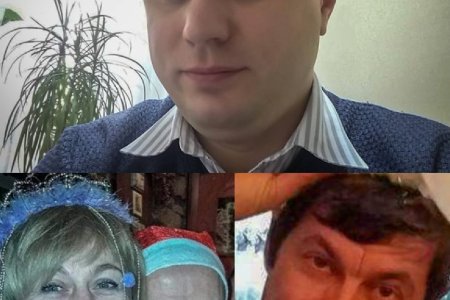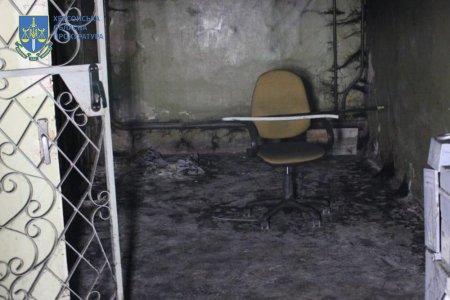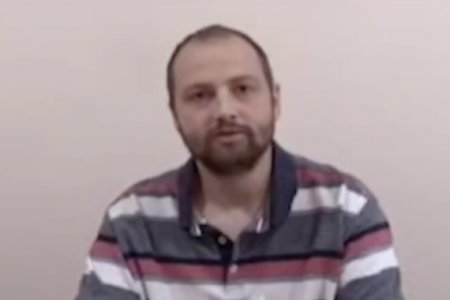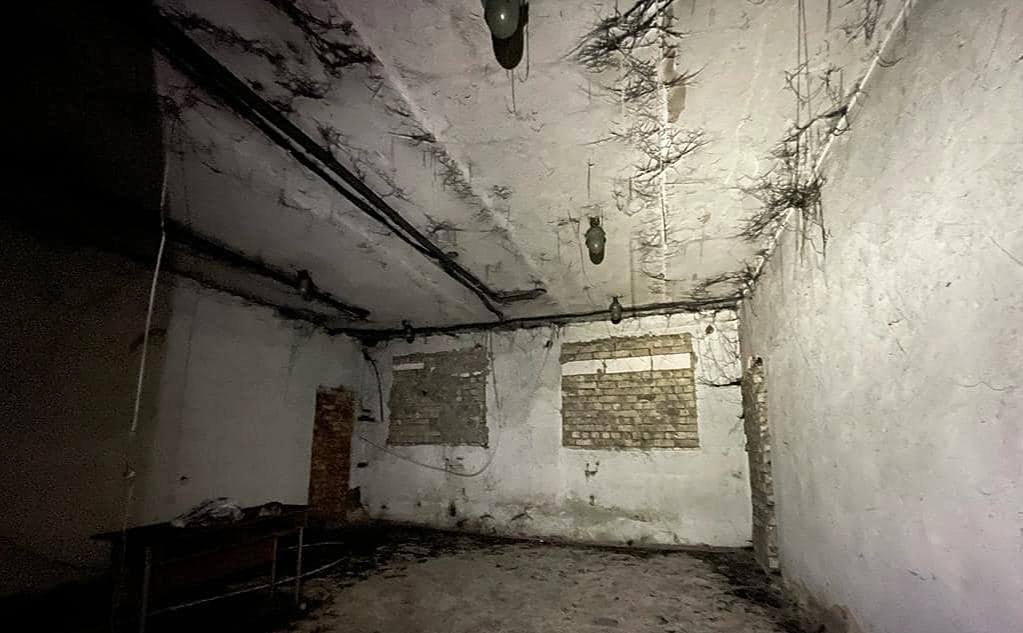
Of almost two thousand Ukrainians abducted by the Russian invaders in Kherson oblast alone, over 923 remain in captivity. While some, like Iryna Horobtsova, Serhiy Tsyhipa, Appaz Kurtamet and his father Khalil Kurtamet were later subjected to show trials, others continue to be held incommunicado, with no charges laid. The number of hostages either tortured to death or who died through the refusal to provide medical care may, unfortunately, be higher as the whereabouts of some of the hostages, including 77-year-old Spanish volunteer Mariano Garcia Calatayud [Mario] The statistics presently available were given on 4 March 2026 by Oleksiy Butenko, head of the war crimes investigations at the Kherson Regional Prosecutor. He was speaking at the presentation of an important new study, carried out by the Media Initiative for Human Rights [MIHR], entitled Scene of the Crime: Chonhar. - on Russia’s imprisonment of civilians in occupied Chonhar (Kherson oblast), where former hostages have recounted how they were subjected to physical violence, torture, psychological pressure and solitary imprisonment. The Russians have used such methods in effectively all of the cellars, school buildings and other premises which they set up to hold civilian hostages. Here, however, MIHR has documented how the Russians immediately seized the Chonhar administrative border checkpoint between Kherson oblast and Crimea. Although the premises were in no way adapted for use as a prison, it became clear by 2023 that the Russians were using the checkpoint building as a makeshift torture prison for civilian hostages and have since fully integrated this into Russia’s penitentiary system.
During the presentation, MIHR Director Tetiana Katrychenko explained that her organization had, since 2016, been monitoring the repression which Russia brought to Crimea and occupied parts of Donetsk and Luhansk oblasts. They were, therefore, in no doubt that Russia would expand and systematize its persecution of civilians in any other parts of Ukraine which fell under Russian occupation. “We already knew how the Russian Federation would behave on occupied territory. It was clear that there would be mass arrests of civilians for their part in protests, for their pro-Ukrainian position, for the very fact of opposition to occupation.”
Civilians began disappearing in any part of Ukraine that was seized by the Russians. It became clear after the invaders were driven out of Kyiv oblast, later from parts of Kharkiv oblast and from Kherson, that some of those abducted had been murdered. Others were taken prisoner, with some of the premises used as makeshift torture prisons coming to light after the Russian retreat.
Kherson was only liberated on 11 November 2022, and other parts of Kherson oblast remain under Russian occupation, as is a large part of Zaporizhzhia oblast. It became clear in July 2022 that many of the civilians abducted in those two oblasts had been taken to occupied Crimea, with Russia having opened two new SIZO, or remand prisons. Of particular concern was SIZO No. 2, which was under the total control of the FSB, and has, indeed, been used for political prisoners, including very many hostages who have been imprisoned for years without any charges being laid. During the presentation on 4 March, Olha Skrypnyk, Head of the Crimean Human Rights Group, said that it is now clear that Crimea was both one of the main bases for Russia’s full-scale invasion, and the centre for the creation of a system of persecution on territory seized in 2022.
Human rights groups first learned of people being held prisoner at the Chonhar checkpoint in early 2023, although the report traces the first arrival of abducted civilians to 20 December 2022.
They included several members of Serhiy Barchuk’s family. As reported, Barchuk was Deputy Head of the Kherson regional branch of the Pension Fund. As well as categorically refusing to collaborate with the invaders, he also carried out instructions and tried to hide the Fund’s computers so that the invaders could not get hold of the Fund’s database. After Serhiy vanished, his father Artem Barchuk; stepmother Lidiya Podozerska, uncle and a close friend of the family understood that he had been seized by the Russians and tried to hide the computers themselves. They too were taken prisoner and eventually held at Chonhar. The family were among the few who were after almost a year, released for a huge ransom.
Artem Barchuk recounted to MIHR how they were first held prisoner in Kalanchak and then taken, in very rough manner, to Chonhar.
“From the first moments, everything was done brutally. Around 70% of the most terrible things that we endured were specifically in Chonhar. We were driven, with screaming, abuse and blows, into a closed room without windows or doors. They forced us onto our knees, put our bags in front of us and ordered us to hold our head, bent, You were prohibited from moving. I slightly moved my head and was hit with the gun barrel on my back.”
They were forced to stay like this for around half an hour while the men were taken one by one into a neighbouring room from where they could hear screams “like the screams from torture”. “They lead you bent over, your hands behind your back, upwards, you run, almost falling. You’re dragged into a room, ordered to strip naked … “. The whole exercise was clearly also about humiliating the men who were questioned about who they were, “why” they’d been detained, etc. while completely naked, and were then allowed to take only the most necessary things of their things that had been laid out by the guards on the table.
In January and February 2023, the number of prisoners rose significantly. The conditions were harsh, with the guards coming up with new restrictions all the time. First, they just weren’t allowed to lie on the bunks during the day, then they couldn’t keep their legs on the bunks, they had to be hanging on the side. This may be one of the reasons why almost all of the prisoners suffered from swollen legs, although MIHR reports that a prisoner still held there wrote in a letter that he suspects that they put something in the food, causing constant weakness. There were other restrictions also, all aimed at making the men’s life more intolerable.
And it got worse, with any so-called ‘violation’ resulting in violent ‘punishment’. The doors of the cell would open and five or six men in masks would burst in, forcing the men out into the corridor, where they had to stand with arms raised and legs wide apart, with their head to the wall. That alone was painful, but the ‘guards’, carrying out a so-called search, would also shout, kick people or use their rubber batons against them. If a person collapsed, they would beat him while he was lying there.
The sanitary conditions were appalling the food inadequate and medical help was not provided in any timely manner.
Lidiya Podozerska, who took part in the presentation, was taken to the so-called women’s cells at Chonhar on 18 February 2023. Although the Russians had come up with female guards, they didn’t provide any showering facilities, with Lidiya unable to wash at all for several weeks. The conditions for women were also appalling and although the women were not beaten as much as the men, they were often treated in degrading manner.
Nor was it the case that they were not beaten at all. They were, on the ribs, legs, over the whole body, just not on the face, so that, when ‘commissions’ arrived to check the place, the women could be forced to say that all was well. Lidiya did hear of the death of several prisoners, and notes that the treatment became much more savage if Ukrainian defenders had had some military successes.
During the presentation, Lidiya also mentioned something her husband had said about the so-called ‘confessions’ that were extracted through torture. He commented that on occasions where a person has stated during the so-called ‘court hearing’ that he had ‘confessed’ under duress, the hearing would be adjourned, while the prisoner was taken away and ‘worked on’. After what was almost certainly more torture, the person did not do so again.
It should be noted that even in those cases where political prisoners have provided detailed and harrowing accounts of the torture to which they were subjected, these have been ignored by the Russian or occupation ‘court’. On those very few occasions, where a supposed ‘check’ has been ordered, these are mere formalities, with the torture denied, and the ‘trial’ continuing to its predetermined outcome.
Chonhar, Tetiana Katrychenko stresses, is no isolated case, but a part of a broader system of Russia’s persecution of the civilian population which bears all the hallmarks of a crime against humanity.