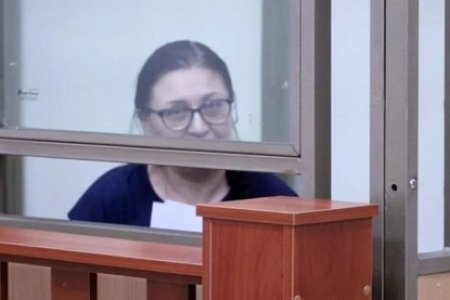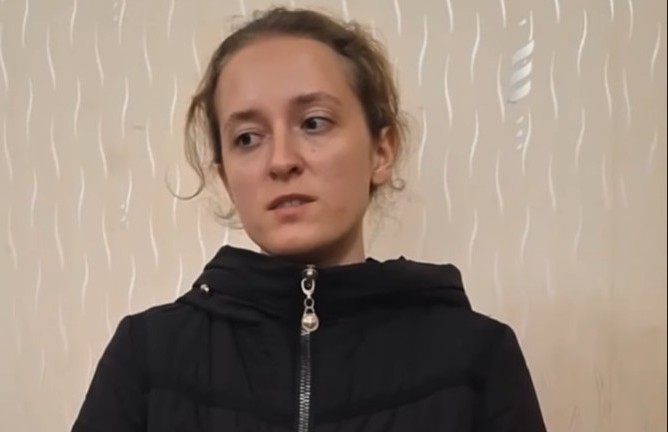
A Russian military court has sentenced 26-year-old Victoria Kotliar to 22 years’ imprisonment for a supposed attempt on the life of the illegally installed ‘head of the prison service’ in occupied Donetsk oblast. Despite the aggressor state’s claim that this was a terrorist attack, such an individual would be a perfectly legitimate target if such an attack were ever planned, and if Victoria, then 24, was in any way involved. It is, however, just as likely that the young Ukrainian was abducted and tortured into providing a videoed ‘confession’ that sounds as though it has been learned by heart.
Victoria Kotliar (b. 02.03.2000) is from Volnovakha, a city in Donetsk oblast which came under occupation soon after Russia launched its full-scale invasion of Ukraine in February 2022. As is increasingly often the case, virtually the only information available is that provided by the Southern District Military Court in Rostov, where the ‘trial’ took place behind closed doors, and Russian state media and the occupation Telegram channel which posted the young woman’s supposed ‘confession’
There are odd gaps in the indictment, with respect both to information and to the rather long period elapsing between Kotliar’s alleged surveillance of the occupation prison chief and the alleged attempt on his life. Since the information she was claimed to have provided was about the individual’s normal routine, a difference of several months and of season might well have been significant.
It is claimed that an unidentified official from Ukraine’s Security Service [SBU] had established contact with Kotliar between 15 and 30 March 2023. In the course of this communication with an “unidentified” SBU official, Kotliar was supposed to have agreed to help him by gathering and sending him information about Russian military personnel. On the video, she says “for money”, with this a standard element of all FSB ‘confessions’. The person must be shown to have been working for Ukraine, but under no circumstances must there be any suggestion that they were impelled by love of their country.
From 5 to 30 August 2024, Kotliar was supposed to have observed the occupation prison chief, described in the reports as a representative of the so-called ‘Donetsk people’s republic [DPR]’ enforcement bodies. She was also claimed to have agreed to try to blow this individual up.
Between 20 and 23 October 2024, Kotliar had, purportedly, received the coordinates of a hiding place with an explosive device and gone there to pick it up. She had then, allegedly, taken it to her home and set about changing its appearance so that it would not be detected. All of this was again alleged to have been on instructions from the unidentified SBU official, as was the video she supposedly took of the home of the occupation prison head and his means of transport, which she passed to the SBU official.
She allegedly took the explosive device on 25 October 2024 to the block where this ‘prison chief’ lived and planted it between a bench and a rubbish bin. She then detonated this using a remote control when the prison chief was very close. There was, supposedly, an explosion, but this did not pose any danger as the main charge of the explosive substance in the device was an imitation. It was, purportedly, after this that Kotliar was seized.
If there was such an attempt on the prison chief’s life, it was both warranted and aimed at ensuring that he was the target. There is, unfortunately, also a chance that this was one of the FSB’s notorious set ups or ‘provokatsiya’, with that explaining the fact that the explosive device failed.
Credibility is not enhanced by the videoed ‘confession’, its circulation by the so-called ‘DPR defence headquarters’; and the degree to which Kotliar appears to be reciting something. We know from essentially every victim who has since been released or received access to an independent lawyer, that such ‘confessions’ are typically extracted through torture and / or threats. There have been several occasions where such videoed ‘confessions’ are very different from the final indictment, with the only conceivable explanation being that the ‘confession’ was given under duress.
All of this was used for illegal charges under Russian legislation against an essentially abducted Ukrainian citizen by an occupying power. Kotliar was accused of ‘involvement in a terrorist organization’ under Article 205.4 § 2 of Russia’s criminal code; of ‘an act of terrorism (Article 205 § 2a; of explosives charges (Article 222.1 § 4) and of ‘treason’ (Article 275). Russia has made it all but impossible to live on occupied territory without taking Russian citizenship, and then turns such citizenship into a weapon, with Russia calling them ‘Russians; and bringing charges that alone carry sentences of 12-20 years.
The ‘trial’ was before Vitaly Victorovych Mamedov, an individual who has taken part in multiple sentences against Crimean Tatar and other Ukrainian political prisoners. The young woman does appear to have had a lawyer, however all information was concealed, and it is not clear whether this was a lawyer of her choice or a state-appointed person who may have simply been there ‘for the paperwork’. The sentence is horrific: 22 years’ imprisonment in a medium-security prison colony (the harshest available for women prisoners) and a 600 thousand rouble fine.
The sentence can, and should, be appealed, however there is no evidence of even a single such ‘trial’ having ended in an acquittal, with the Russian appeal courts at very most slightly reducing a sentence. Victoria Kotliar has been added to the Memorial Support for Political Prisoners Project list of other victims of persecution. This is when there is too little information to enable the thorough analysis that precedes recognition of a political prisoner, but where political motives seem very likely.