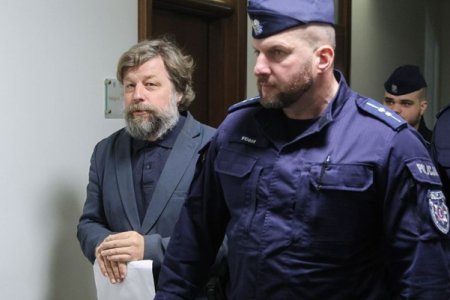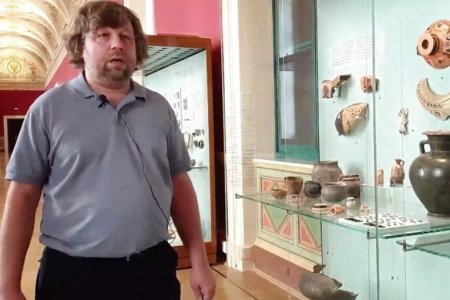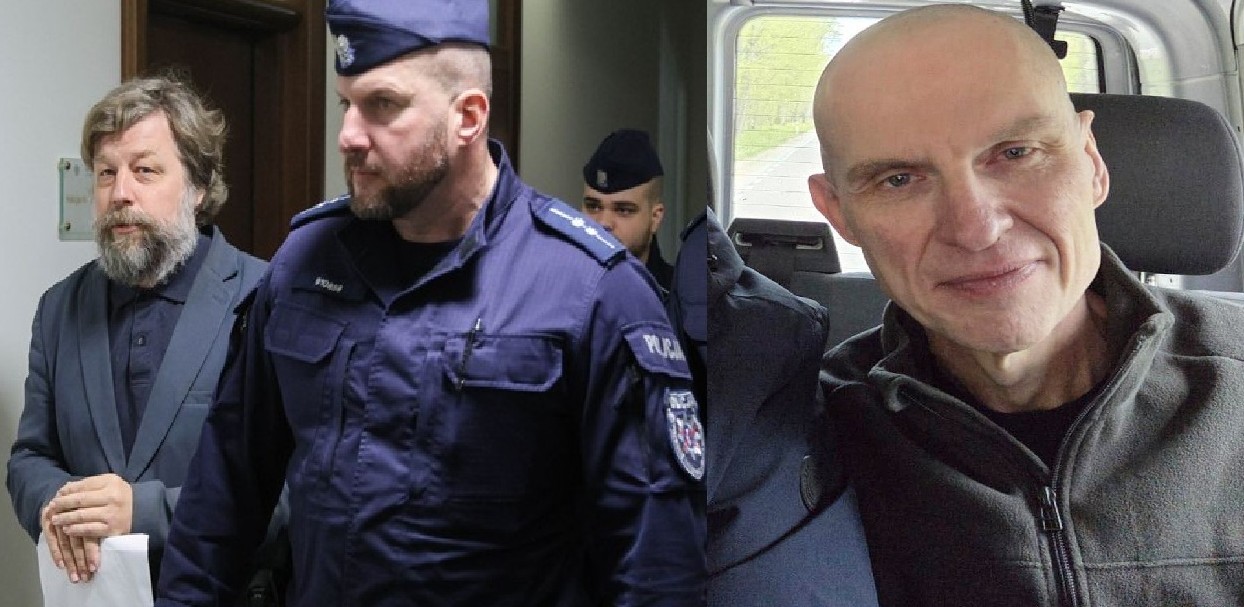
Russian archaeologist Alexander Butyagin will not be extradited to Ukraine to face trial over his role in Russia’s illegal excavations in occupied Crimea. He was returned to Russia on 28 April in an exchange of prisoners which saw the Belarusian regime finally free Polish and Belarusian journalist and civic activist Andrzej Poczobut. The outcome, so soon after a Polish court ruled that Butyagin could be extradited to Ukraine, is frustrating, however the Belarusian regime had long refused to release Poczobut who looked drained and dangerously thin. Although it seems likely that Kyiv was not informed in advance, Ukraine has also faced similar dilemmas and has, on several occasions, made very difficult decisions in order to secure the release of the Kremlin’s Ukrainian political prisoners.
Butyagin had been in Polish detention since early December 2025, with the Warsaw Circuit Court having given its consent for his extradition to Ukraine on 18 March 2026. The ruling had already been appealed by Butyagin’s lawyers and was, in any case, understood to be a decision that would be made by Poland’s Minister of Justice. His arrest clearly sent shockwaves through academic and research institutes in Russia, with Russia’s ministry of science and higher education reportedly advising them to carefully assess whether they should travel to what the current Russian regime views as ‘unfriendly countries’. The EU’s latest sanctions list published on 21 April 2026 named four Russian ‘cultural figures’, including two men – Andrey Polyakov and Nikolay Makarov directly implicated in Russia’s illegal excavations in Crimea and Mikhail Piotrovsky, Director of the State Hermitage Museum where Butyagin heads the Department of Northern Black Sea region archaeology. If Butyagin himself was not added in order to not interfere with the extradition proceedings, it is to be hoped that this will soon change, especially since Ukraine’s wish to try him for illegal excavations and complicity in Russia’s looting of valuable artefacts remains unchanged.
The exchange on 28 April took place on the Polish and Belarusian border with five people handed over from each side. It is not clear who else Belarus released, but 53-year-old Andrzej Poczobut had long faced persecution under the Lukashenko regime and had been imprisoned since March 2021. It is somewhat galling that Ukraine does not appear to have been consulted given that Russia clearly played a major role in the exchange, with the Kremlin presumably applying pressure on Minsk to release Poczobut so that they could get Butyagin back. The current US administration was, seemingly, also involved, with Ukrainian journalist and political analyst Vitaliy Portnikov reporting that Warsaw had been placed under pressure to release Butyagin, and may have sought to at least secure Poczobut’s release in exchange. Portnikov likened the pressure on Poland to that allegedly brought to bear on the USA’s European Union partners to not use frozen Russian assets to help Ukraine. The US administration reportedly claimed that this would disrupt US president Donald Trump’s supposed ‘peacekeeping efforts’.
Ukraine’s Foreign Ministry responded to the news that Butyagin had been handed over to Belarus / Russia “with regret”, especially following the entirely warranted ruling on 18 March by the Warsaw Circuit Court. Daryna Pidhorna, a legal expert from the Raphael Lemkin Society and member of the Crimea Platform writes that countries do have the right to opt for an exchange, rather than extradition, however they should carry extradition proceedings through to the end, and certainly inform the country seeking the extradition. Here the USA and Russia would appear to have known, not Ukraine. Pidhorna calls its a dangerous precedent where theoretically any extradition proceedings can be cancelled via a diplomatic exchange and without proper explanation to the main interested party..
While Russia and Russian propaganda media will, undoubtedly, be gloating over the success in avoiding Butyagin’s extradition, any attempt to use this, as predicted by Ukraine’s Foreign Ministry, as justification of its occupation of Crimea is anything but warranted. Whether or not this was with US administration assistance, it was a ‘deal’, in which a political regime unjustly imprisoning Andrzej Poczobut agreed, in exchange for benefits from Russia and / or the US to ‘sell’ his release in exchange for Butyagin escaping justice. Russia has been holding Ukrainians hostage and demanding huge ‘ransoms’, often in the form of such releases, since 2014. After Russia’s full-scale invasion of Ukraine in 2022, the numbers of civilian hostages, Crimean Tatar and other Ukrainian political prisoners in Russian captivity have increased exponentially, with it often extremely difficult to find a ransom that will tempt Russia. The latter not only behaves like a criminal in demanding ransoms but increasingly protects strictly criminal ‘interests’.
In 2017, for example, it is likely that Russian leader Vladimir Putin agreed to the release of two highly respected Crimean Tatar Mejlis leaders - Akhtem Chiygoz and Ilmi Umerov, after Turkey agreed to hand over two Russian state-sponsored killers - Alexander Smirnov and Yury Anisimov. Both Russians had been facing charges in Turkey of spying and a political killing
Another prisoner exchange was even more incriminating. In September 2019, Russia handed over Putin’s Ukrainian political prisoner No. 1 Oleh Sentsov and 10 other political prisoners, as well as 24 Ukrainian seamen illegally imprisoned after Russia opened fire on their naval vessels. This was no ‘good will gesture’. Putin needed to get Volodymyr Tsemakh, MH17 suspect / witness and a Ukrainian national away from the Dutch prosecutors investigating the downing of the Malaysian airliner by a Russian BUK missile brought from a Russian military site to occupied Donbas on 17 July 2014. Although Ukraine’s Constitution did not allow it to extradite a Ukraine citizen to Holland, it could provide full access to the Dutch investigators in Ukraine. Kyiv’s decision to hand Tsemakh over to the Russians was doubtless frustrating to the Dutch Prosecutor and the Joint Investigation Team [JIT], formed by the Netherlands; Australia; Belgium; Malaysia and Ukraine after Russia vetoed a UN investigation into the disaster which killed 298 passengers and crew. There did, however, seem to be understand of Ukraine’s difficult position. That Russia’s motives were entirely clear to all interested parties was expressed very bluntly by the Dutch Prosecutor in December 2019. Moscow was accused of deliberately obstructing the investigation into MH17 by quickly getting Tsemakh to occupied Donbas in order to avoid being obliged to extradite him in accordance with the European Convention on Extradition.
Such measures from the Kremlin were an effectively admission of guilt, and ultimately pointless. The Dutch Prosecutor and JIT amassed a vast amount of evidence demonstrating the degree to which Moscow was in control of events in occupied Donbas and proving how the Russian BUK missile launcher was illegally transported into occupied Ukraine and then hurriedly returned after the downing of MH17. The evidence was used to convict two Russians and a Ukrainian on 17 November 2022, and in the 12 May 2025 ruling by the UN’s Civil Aviation Organization [ICAO] which found Russia responsible for the downing of MH17. On 9 July 2025, the European Court of Human Rights issued a crucial judgment finding, among other things, that agents of the Russian state were responsible for the downing of MH17.
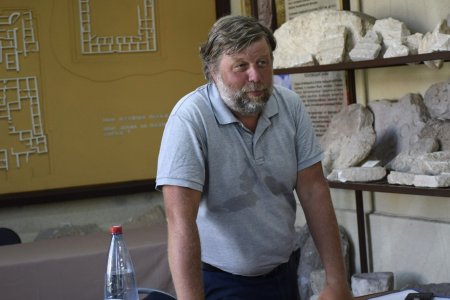
Butyagin will continue his illegal excavations in occupied Crimea, with Russian propaganda media likely to step up its coverage in order to gloat over Ukraine’s ‘failure’. It is, however, unlikely that he will be venturing abroad for a while as Ukraine’s warrant for his arrest remains in force, and the extradition request was not rejected, just bypassed in a political move.