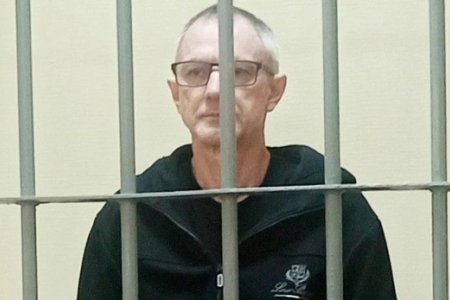
As reported by Mediazona, Bohdan Ziza is in correctional colony No. 8 in Buryatia, and he was immediately sent to solitary confinement for ten days, allegedly “for not presenting himself properly”. Bohdan himself wrote about this in a letter. “A kind of tradition is already emerging — to start life in a new place from ‘the hole’. But everything is fine,” the journalists of Mediazona quote the artist.
Before that, Bohdan Ziza was held in the “Volodymyr Central”. In 2023, immediately upon arriving there, Bohdan was also placed in an isolation cell for refusing to wear a prison uniform.
Bohdan Ziza’s case
Bohdan did not accept the 2014 occupation of Crimea. But he could not leave the peninsula: he was caring for his sick grandmother. Early in the morning of May 16, 2022, he poured water on the facade of the city administration in Yevpatoria and threw an incendiary mixture through the window. However, there was no fire, and no one was injured.
Traces of a “terrorist attack” on the building of the occupation administration of Yevpatoria
Ziza still managed to edit a video of the performance: “There is a terrible war that Putin unleashed, and the entire state propaganda machine is trying with all its might to convince the people that this is normal. It is trying to convince everyone that nothing needs to be done, that no one can do anything. But now it is very important to go out and express your protest. So that those who are against this war but are sitting at home, afraid to express their opinion, see that they are not alone: there are many of us. And there are more of us than those who support this war. But they took away such an opportunity from us. They took away the opportunity to go out during the day. But we can go out at night. I urge everyone to go out at night and express their protest. Vandalism can be for the good, and this is exactly the case. No to war!”
Soon they came for the artist. On the same day, a video was posted on local social media, in which Bohdan, with his T-shirt torn at the neck, nervous and scared, allegedly confesses to his crime and asks for forgiveness. “I am ready to suffer punishment and atone for my guilt with hard labor,” he says in the garbled language of propagandists. Later, the artist will tell how this “repentance” was filmed: how it was beaten out of him: “There are at least five videos with my apology. The first one made the media, the second was in the case files, and a few more were rejected. FSB officers filmed them. At first, they calmly ask me to say everything they need on camera. Then, when I refused, they started to persuade me, threatening me in the process. First, they forced me to record one video, which they sent to some of their superiors for review. Then another one: when they received a reply, I was not repenting sincerely. I deliberately did not show any emotions, so they beat me again. I am not a very good actor, and the text was constantly changing. So I had to apologize to the Russian army, then to Putin. As a result, even they realized that the latter was unnecessary.”
The artist was later charged with four articles: Art. 205 Part 1 (committing a terrorist act), Art. 205 Part 1 (threat to commit a terrorist act), Art. 205.2 Part 2 (call for terrorism), and Art. 214 Part 2 (vandalism for political reasons). On June 6, 2023, the Southern District Military Court in Rostov-on-Don, Russia, sentenced him to 15 years of detention, with the first four years to be served in prison. On June 10, the man went on a hunger strike demanding that he be stripped of his Russian citizenship and that Ukrainian political prisoners be released from Russian prisons. For this, he was placed in solitary confinement. On June 27, Bohdan ended his hunger strike due to his health; in 17 days, he had lost 10 kilograms.
Thousands of kilometers from home
At the end of 2023, Bohdan Ziza was transferred to the Volodymyr Central prison in Volodymyr, despite this violating international humanitarian law, which provides that an occupying state does not have the right to deport persons detained for any offenses from the occupied territory to its own territory. Now he has been taken even further from Crimea. Last September, it became known that Bohdan Ziza had nevertheless renounced the Russian citizenship imposed on him.
“This is the beginning of the 5th year of imprisonment. I have not heard from Bohdan at all in all these years and, in fact, have not seen him. Because during all the court hearings, we sometimes see photos of civilians or prisoners of war appear, and Bohdan was under some ban. And later we learned from the lawyer that at one of the court hearings he was badly beaten, he was deliberately hidden so that no one would see the consequences, — Bohdan’s sister, Oleksandra Barkova, told in a recent interview with Suspilny Krym in May of this year. — For him, it all became a big struggle when he ended up in prison. He learned more about political prisoners and got to know them. And he even says in his speeches at the court that for him it is a ‘bigger struggle’. He does not ask to release himself; he asks to release everyone. And he also writes to me in personal correspondence that he would even be upset if he were released first, and not those who need it more.”
Human Rights Project “Support for Political Prisoners. Memorial”, guided by international criteria, considers Bohdan Ziza a political prisoner. “Ziza’s criminal prosecution violates his right to a fair trial, and the ostentatious severity of the sentence is designed to intimidate opponents of Russian aggression against Ukraine,” human rights activists say.
By persecuting civilians in the occupied Ukrainian territories, Russia violates many norms of international humanitarian law. The Russian Federation is introducing its own criminal legislation, despite this contradicting Article 64 of the Fourth Geneva Convention. Civilians are subjected to “enforced disappearances”, kept for weeks without contact with their families and lawyers. Procedural norms are observed only formally. Abducted civilians are transferred to the territory of the Russian Federation, although this is prohibited by Article 76 of the Convention for the Protection of the Civilian Population.