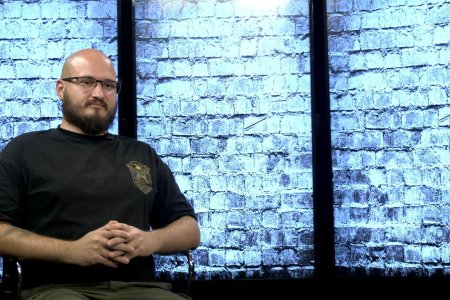
He asks to be called only “Bro-wolfie,” clarifying that his name is not Vova or Volodya.
He explains it in the following way: “You know, I’m a bit paranoid, so I don’t like being called by my official passport name and similar. I’ve been called Bro-wolfie, meaning ’little wolf,’ for a long time. Also in fairy tales, there is a character named “Bro-wolfie” (little brother wolf), so I received that name."
In fact, it’s no secret that Bro-wolfie’s name is Mykhailo. Once a resident of the Kyiv region, he participated in the Maidan protests and helped extinguish a fire in the Trade Union building. However, after the Revolution of Dignity, Mykhailo did not return to a peaceful civilian life. In the early months of the Russian aggression in Crimea and eastern Ukraine, Bro-wolfie joined the then-volunteer Azov Battalion.
During the anti-terrorist operation, he participated in the liberation of the city of Maryinka in Donetsk Oblast and in defensive battles around Shyrokyne village, located near Mariupol. Mykhailo has been serving since 2014 and has gone from a simple volunteer to a full-fledged soldier in the Azov regiment of the National Guard of Ukraine. He served in Mariupol when the full-scale Russian invasion began. The Azov soldiers were preparing for a possible escalation and new threats in 2022, but Bro-wolfie himself doubted it until the very end.

Mykhailo recalls his assumptions and train of thought as follows: “I am just sharing my personal opinion. As for our unit — yes, we passed intensive training, and everyone knew their tasks, sectors, etc., in case something started. But personally, until the very last moment, I couldn’t tell whether the Russians were really ready for such losses. I understood that for the potential occupiers, it would not be a leisurely stroll in any sense. It means they will suffer very heavy losses. I remember the discussions about the Afghan war and its consequences. I also remember the war in Chechnya, even though I had nothing to do with it, of course. Then everyone was shocked by how many casualties there were in a week, a month, and so on. But that was a war with tiny Chechnya, while now Russians would be trying to capture the largest country in Europe. I was right about the casualties but wrong about the Russians’ reaction to them. It turned out that they didn’t care."
The start of the full-scale invasion proved especially difficult for Bro-wolfie. In the early days of the Russian offensive, he was seriously wounded, even though he was not at the front line. Mykhailo was driving a car and performing logistical tasks when the occupiers shelled a residential area of Mariupol as Bro-wolfie’s car was passing by. A Grad MLRS shell fell just a few meters from the unarmored car, and the man lost his leg almost immediately.
“I don’t remember anything else. I only came to my senses a few weeks later at a civilian hospital in Mariupol. As it turned out later, someone had brought me there without my personal belongings, my uniform, my documents, or my phones. And that saved me. Because when the Russians entered the hospital, they were looking for soldiers. And I wore, excuse me, only my briefs. I don’t have any tattoos and never have, and, let’s be honest, I’m at such an age... If I had been in uniform or had any belongings with me, I wouldn’t even have been able to hide these marks of my military status while unconscious,” says Mykhailo. He still doesn’t know who saved him by hiding his belongings.
The hospital, like much of Mariupol, was occupied relatively quickly. While fighting continued in the city and Mariupol’s defenders controlled the Azovstal plant, a humanitarian disaster was unfolding in civilian medical facilities.
“Many doctors and staff fled when the war began, and I can understand that. The hospitals were overcrowded, with people lying in the hallways and corridors. There was very little medical staff available. There was no food to eat. Several times during this period, we were given a regular plastic cup containing a single potato, some soup, and a backbone. But we didn’t want to eat as much as we wanted to drink. They began draining technical water from the heating system. We drank it because there was nothing else,” Mykhailo recalls.
He says that every few hours, they could hear Russian aircraft bombing the Azovstal plant and other parts of the city. Russia’s complete control of the skies over Mariupol largely determined the fate of the city’s defenders. Constant shelling disrupted sleep, while the lack of food and water caused rapid weight loss. At the same time, Mykhailo’s other leg injury worsened.
“The Russians constantly strolled through the hospital, interrogating patients. A man was lying not far from me who was also wounded. During the interrogation, they found some of his belongings, and he confessed that he was a serviceman and an officer. They took him somewhere. After a while, I heard automatic weapon fire on the hospital grounds. At that time, there had been no small arms fighting in the area for a long time, not a single shot. I asked one of the orderlies what was going on. They told me that all service members who were lying in this hospital had been gunned down. But I didn’t see it myself.”

Later, patients from the Mariupol hospitals were gradually transferred to Donetsk. There, Mykhailo had his second leg amputated. While in the hospital, he underwent what is known as “filtration” — a check by the Russian special services that included testing his loyalty to the occupiers. However, Bro-wolfie says he managed to “attract no unnecessary attention” because of his age and a severe injury, a double amputation.
“There, I was able to buy a simple manual wheelchair. I started to roll out into the hospital courtyard and thought only of ways to return to the territory controlled by Ukraine as quickly as possible. There was little information. For a long time, I had no means of communication, not even a phone. While we were still in the hospital, I heard the occupiers say that Kyiv had already been occupied and that Russians were allegedly finishing off our forces somewhere in western Ukraine’s backyards. But real information was nevertheless somehow conveyed, at least in general terms. And it quickly became clear that this was not the case,” Bro-wolfie recalls.
Not waiting to complete the treatment, the man reached an agreement with volunteers who could return him to the destroyed Mariupol. There, Mykhailo began developing a rescue plan despite a serious injury, no money, and no documents. By that time (summer 2022), the defense of Mariupol had concluded, and the city was under the occupiers’ complete control.
"I didn’t witness the process of the city’s destruction firsthand. I was wounded almost immediately, before the city was really bombed like that. I was caught in one of the earliest shellings. And then I was in the hospital all the time. Then I was transferred directly to Donetsk. I realized what they had done to the city only when I returned to Mariupol in the summer. It was not even possible to immediately determine which street you were on. Everything around was smashed. About 80% of buildings were either completely destroyed or severely damaged. It was difficult to find an undamaged house or building.”
In the summer of 2022, it was still possible to try to leave for the Zaporizhzhia oblast with volunteers, passing through numerous checkpoints operated by occupiers. However, there was no guarantee that Mykhailo would not be detained at a checkpoint, where he could be exposed as a former serviceman. Nevertheless, he attempted.
“I found some people who were still able to travel to the Zaporizhzhia oblast at that time. There were a lot of checkpoints. Kadyrovites operated them. Many people say, and it is true, that they did not fight in the trenches but terrorized civilians at checkpoints and around the city. I heard one of Kadyrov’s men threaten a man in another car, promising to leave him in the occupied territory to “dig trenches.” Of course, corruption was rampant among them. Do you want to get through the checkpoint? Give a kickback. And it happened at every turn.”
Mykhailo says that when he managed to get past the last checkpoint held by the occupiers and escape to Ukrainian-controlled territory, he felt a great sense of relief and joy, but for a long time, he couldn’t believe that everything had worked out. At the Ukrainian checkpoint, he immediately admitted to being an active member of the Azov Regiment and recounted the events of the past few months in detail. Mikhailo’s documents were subsequently restored, and volunteers helped him return to the capital.
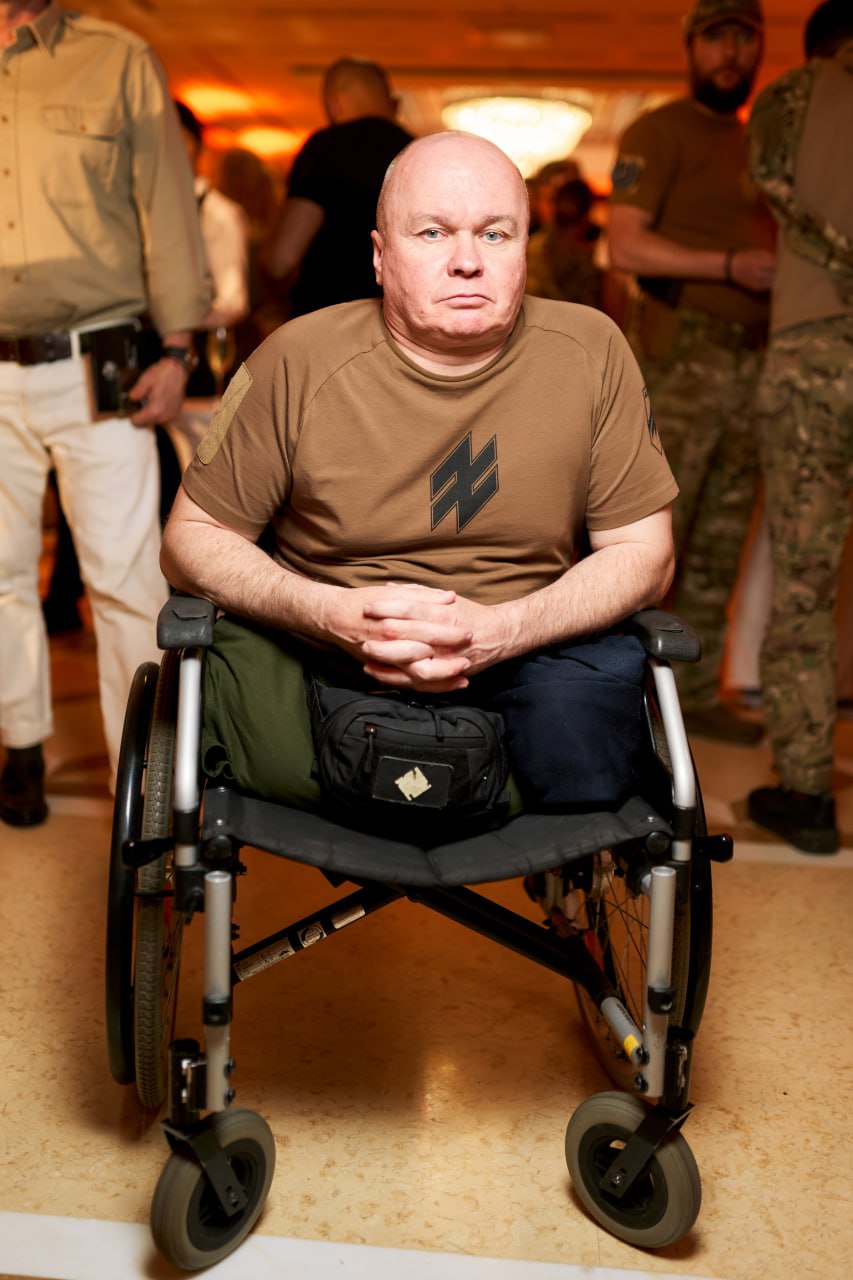
In Kyiv, Bro-wolfie underwent numerous operations; there were still shell fragments in his body, and some remain there to this day. He underwent complex medical procedures, rehabilitation, and attempts to walk on prosthetics, but all the ordeals did not break Bro-wolfie and did not even deprive him of his optimism.
"Our Azov patronage service supported me a lot from the very beginning. They arranged my surgeries and treatment and generally helped me. Even now, several years later, I can still turn to them for help with any needs, and they help me quickly. My brothers-in-arms also bought me a special car with manual controls. I can roll in myself: the car has a special ramp, and I can roll my wheelchair right into it. The car is also controlled manually. I am completely mobile and drive around the city as needed,” says Bro-wolfie.
Mykhailo was also provided with a modern electric wheelchair that enables him to travel long distances. The wheelchair is controlled by a special joystick and powered by an electric motor. It has enough batteries to cover the distance of two or three metro stations and back, but in winter, that distance may be shorter because batteries discharge faster.
Bro-wolfie, as befits a man with such a nickname, loves to walk in the woods. For this purpose, he bought a small quad bike, which he also operates himself. Mykhailo says he does not drive recklessly because sometimes he has had to push the vehicle out of puddles himself.
Mykhailo also has an official job in addition to participating in campaigns to release prisoners of war and walking in the woods. He got a job as a line operator for the 112 emergency service. Now he responds to urgent calls from citizens throughout Ukraine, as the 112 service is the joint hotline for the State Emergency Service, police, and ambulance services nationwide.
"I didn’t feel any skepticism toward me. I passed the required selection process. Then there was training. The Ministry of Internal Affairs helped me a lot by adapting my workplace to meet my needs. Not only the workplace itself, but everything around it: the paths to it, the restroom, the passageways. In fact, it’s not only for me. Unfortunately, the number of people with similar injuries, having lost limbs, is increasing every day in the country. And these people get jobs, of course."
Mykhailo says that there have already been instances when people who witnessed Russian shelling of residential buildings called the hotline during his shift. In his opinion, military experience can be helpful in such situations, enabling a hotline operator to quickly obtain the necessary information, keep a person calm, and convey key information to the relevant authorities and services.
The veteran often talks about his plans and dreams. In particular, Mykhailo plans to ask his former commanders to install a tow bar on his adapted car.
“You see, when the Kremlin is on fire, we’ll need to deliver additional fuel. And I’m a good driver. I know how much fuel is needed. So we’ll help!”