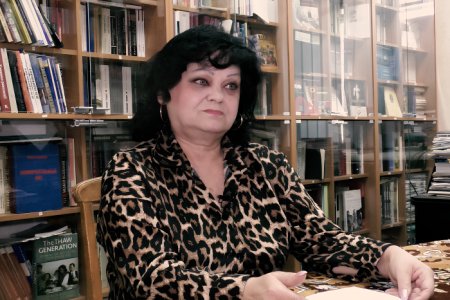
Lesna Stinka is a village on the right bank of the Oskol River, 45 kilometers from Kupiansk. Larysa Fesenko headed the local lyceum since 2009. During the occupation, the Russian authorities demanded that Ms. Larysa begin working for the enemy. After receiving a firm refusal, the occupiers began to coerce the woman.
In July 2022, FSB officers came to her home, searched the house, and took Larysa Volodymyrivna to Kupiansk.
Read the beginning of the story through the links: the split in the teaching staff and the arrest.
“I am the director of a Ukrainian school”
— …They brought me to some place. When they were leading me into the building, the person next to me kept saying: “Step, step, step… we are going down.” I felt dampness and cold, even though it was +40 degrees Celsius outside. I thought: well, that’s it, definitely some kind of basement. And I started to feel dizzy. I heard the sounds of a song, as if someone was singing somewhere. I heard them singing in Russian…
They stopped me and put me against the wall. And I feel someone sitting next to me flipping through some papers. Then they addressed me: “Now, briefly — why were you arrested?” I told them, “Because I’m the director of a Ukrainian school.” And he said, “That’s not short enough!” That’s all he said to me. They pushed me and led me further. Now there was a smooth floor under my feet... But I heard singing, you understand? I thought I had gone mad. Why am I hearing this song?...
They led me to a room, took the sack off my head, and began to search me. A woman searched me in the presence of several guards. They were in black uniforms with “Security” written on them. They stripped me down to my underwear. They took the laces out of my moccasins. They took everything. There was a safety pin in my jeans, and they took that too, just in case. Then they told me to take off my bra; they needed to remove the underwire. I took off my bra, and the woman who was searching me couldn’t get the underwire out and asked a guard for help. He started tearing my underwear. I looked at him and said, “Will you buy me a new one, you son of a bitch?"
![Фото: Харківська обласна прокуратура [Куп’янський ІТТ, катівня]](https://khpg.org/files/img/1608823918.jpg)
The Cell
They led me to a cell. I was already without the sack on my head. The doors were massive, like gates. There was a hole in them, a so-called “feeding hatch,” through which they passed food. They fed us in the morning and evening: they gave us boiled vermicelli with something added. But in reality, it was just cooked pasta, and that’s all.
There were already women in the cell. It was a cell for two people: two bunks, a toilet with a broken cistern, an iron table, and a chair bolted to the floor. There was also a tap from which technical water flowed. And beneath it was a whole mountain of plastic water bottles, because the toilet tank in the cell wasn’t working.
I went into that cell, or rather, they pushed me in, and the gate closed behind me. I was so overwhelmed that the women who saw me immediately advised me to wash my face. I didn’t have anything with me; I didn’t know where I was going or what would happen to me. I washed my face and then felt like I couldn’t breathe. It was unbearably hot, everything was closed, and it was hard to breathe! And I tried to get closer to the “feeding hatch,” because at least some fresh air was coming from the corridor. They were creating a draft there, but in the cells themselves, it was stuffy and hot. There was vapor in the air because of the toilet. So I kept pressing myself against this “feeding hatch” to breathe. The others told me, “Move away, you’re not the only one here."
All the places were taken, so I ended up on the floor. One of my cellmates probably saw how I was and took pity on me. She had some... not even a blanket, but some kind of rag on her bunk. She gave it to me so that I could at least sit on something other than the concrete floor. The floor was covered with linoleum.
I sat down and either sat or lay on that spot on the floor all the time, looking for a crack to breathe through.
![Фото: Харківська обласна прокуратура [Куп’янський ІТТ, катівня]](https://khpg.org/files/img/1608823917.jpg)
We have to keep going
I refused to eat. There were no dishes, so the girls shared a plastic spoon and a small container with me. In the morning, they gave two or three spoonfuls of boiled vermicelli and two pieces of bread. That’s all. And the same in the evening. There was nothing else. The only thing was, some people had relatives who came to visit and brought them little packages... But these seldom reached us: the guards would cut them into pieces, break the cookies, and, if it was a meatloaf, chop it up, thinking the relatives were passing dangerous things into the cell. So everything arrived in that kind of condition... Besides, if the relatives... If they brought the food in the morning, it would reach us by evening. Everything was already spoiled, everything was unfit for consumption... In 45 days, I lost up to 18 kg. Well, I survived.
At first, I didn’t eat anything. And then one of my cellmates said to me, “You understand that you’re not harming them with this. You have to keep going. You have to eat. You have to eat to survive.” But what’s the point? Even if I eat, they’ll drag me out by the feet and throw me away, and that’s it. And no one will remember me... However, I started eating.
The women who were there first already had soap and toothpaste; their relatives had sent it to them. I didn’t have any of that. And at first, they even shared toilet paper with me. Thanks to mutual support, we survived. We supported each other. I also participated in this because the goal was the same — we needed to get out of there.
Interrogations
They threw not only people who were called “political prisoners” into this cell. There were several of us there. But generally, women were thrown in there for various “offenses”: for not observing the curfew; for looking at occupiers “the wrong way”; for making some remark to the Russians who were looting houses; for example, because their husband or son was a serviceman. Why were we considered “political prisoners”? Because we had our own opinion and refused to cooperate.
They once threw one girl in there; she was under 30. The gates opened; they brought her in. I said to her, “Sit down!” And she replied: “I can’t sit down, they beat me so badly that I can’t sit!” I went up to her, and she lifted her sweater and showed that she had been beaten on her legs and lower back. She was beaten by women... She said that they put something on her... something like a padded jacket, and beat her with water bottles. So that there would be no traces… Although they weren’t even afraid of that.

One woman was interrogated with stun guns; they passed electricity through her. She said that at first she heard a conversation: one said “200,” and the other said “Give her 500!” People couldn’t withstand it; they lost control of their bodily functions. Throughout our time in the cell, we felt psychological pressure. Everyone who was brought in was constantly beaten. People were screaming terribly, you understand? I sat on the floor, covering my ears with my hands… What could I do? The screaming was so loud that it was simply impossible to be there. When I finally got home, my colleagues told me how the collaborator, the village headman, said, “Even if she returns, she will be just like a vegetable."
They brought in one Ukrainian man, and it was clear he was a patriot. In the corridor, he shouted: “But I’m still Ukrainian! I’m Ukrainian, I was, and I remain one!” For this, he was beaten very brutally. We heard it. Our “food hatch” was open, and we could hear everything. They beat him until he was hoarse; they probably broke everything in him. He groaned and then just passed out, apparently. And they started beating him again. Most likely, this was pressure on those who were sitting there, you understand? They threatened him: they said they would bring his wife and daughter. Then he said: “No, kill me here, kill me, but don’t touch my family, don’t touch my wife! I beg you, don’t touch them!” And then they just dragged him away somewhere…
And as for the singing, they forced everyone in their cells to sing the Russian anthem several times a day. We were being monitored in the cell, and anything could be done to anyone who didn’t sing and was unlucky enough to get caught.
They took people for interrogations at night. People were already starting to go to sleep, to rest. And at that time, the gates would open, they would call out a surname, and put a hat on your head — a black hat. You couldn’t see where you were going. They tied your hands with tape and led you away. I had an interrogation on the third day. And on the tenth. That’s all, I wasn’t interrogated anymore after that. Only twice.
At the first interrogation, they led me to a room. Before I went in, they took the hat off. The doors opened — a standard room, a regular polished table. There was even a clock on the wall. The atmosphere didn’t inspire fear. I went into the room. There were two of them. The interrogation was conducted by the man who had taken me away; I recognized him. He had very expressive eyes. The first time he came to me and talked to me, he wasn’t wearing a balaclava. I don’t even know his name. Everyone there had their own nicknames... I couldn’t find any information about him anywhere. He was tall, with a reddish beard, about forty years old. In a calm voice, he asked me if I had given back all the keys to the lyceum. I said, “Yes, all the keys are at the lyceum; they stayed there.” And he started asking questions: “Why are you behaving like this? Do you see what kind of situation you’re in?” And I started telling him that they weren’t letting us out into the yard. I have health problems, and I have difficulty breathing. “How long will I be here? Tell me — how long?” He answered me: “I can’t say how long you’ll be here."
Then there was an interrogation on the tenth day. They called me, and the room was not the same as the first time. The interrogation was conducted by a different person. He was a sturdy man with a mole above his upper lip. He looked to be in his late forties or early fifties. Another man was sitting next to him.
They never conduct interrogations alone. The girls in the cell were saying to each other that one person observes you while the other interrogates you. And that’s precisely how it was: one of them, like a psychologist, seemed to be studying me.
When I entered, I saw traces of blood on the floor. I saw an iron table, an iron chair. The whole room was dark green, all the walls were painted, and there were drops of blood on the floor... I didn’t see any torture devices there. The first question was: “How long have you been here?” I said: “10 days.” He said: “Not long enough, too little for someone like you.” My answers were short, and their questions were meaningless. The only thing they were trying to get at was that I loved my homeland so much that I was ready to do anything for it.
To be continued