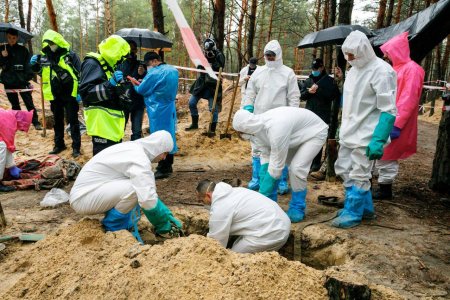
Four years after Russia rained bombs and artillery fire on Sievierodonetsk* in Luhansk oblast, its ‘Investigative Committee’ has begun using the bodies of those killed during the months of Russia’s siege in a cynical stunt to try to rewrite the historical facts. The invaders are carrying out exhumations, asserting that the civilians were killed “as the result of Ukrainian aggression”.
The Russian state-controlled TASS press agency claims that “Up till 2022 Sievierodonetsk was under the control of Ukrainian armed formations [sic!]. After Russian forces entered the city, the nationalist divisions, according to the investigators, continued to carry out reprisals against the civilian population, shooting residents for their intention to receive Russian citizenship and for their appeal for humanitarian aid. Many city residents, sheltering from the Ukrainian artillery shelling, hid in basements which became the place where they died.”
This nonsense will, undoubtedly, be what the supposed forensic examinations will be claimed to have established.
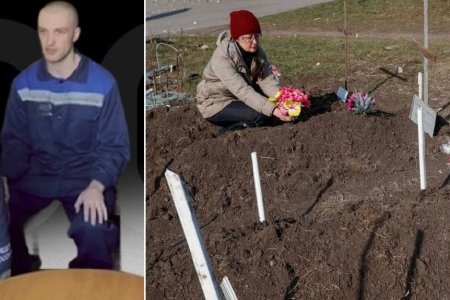
While the exhumation of bodies may be a first, Russia has been seeking to blame Ukraine’s Armed Forces for its most egregious crimes since soon after its full-scale invasion of Ukraine. In 2022, the FSB used a young woman who had been forcibly deported to Russia and was clearly speaking under duress to blame Ukrainian defenders for Russia’s bombing of a maternity hospital on 9 March 2022. Since then. a huge number of Ukrainian prisoners of war have been tortured into ‘confessing’ on video to supposed attacks on civilians, before being sentenced to horrific terms of imprisonment.
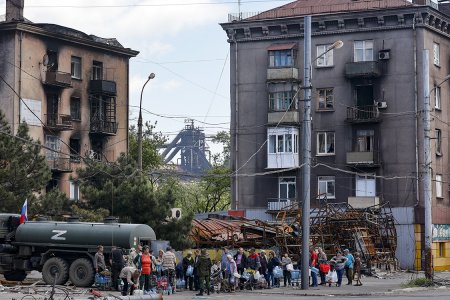
Russia has imposed a near total information blackout on Sievierodonetsk and the neighbouring Luhansk oblast cities of Rubizhne and Lysychansk. As well as the restrictions on any territory under Russian occupation, the three cities seem to have been especially isolated, with the occupiers cutting off even mobile communications.
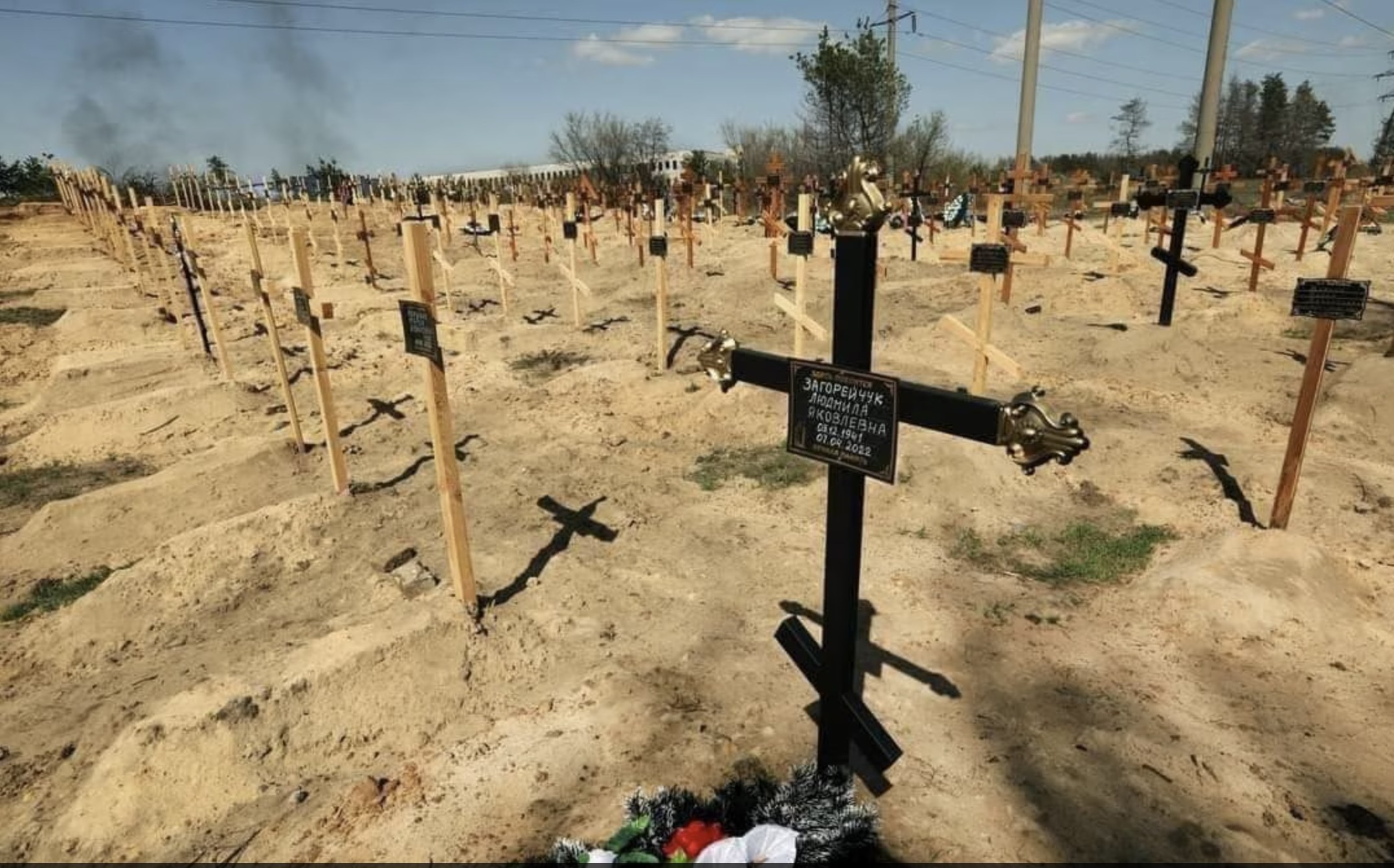
This does not mean, however, that Russia can invent a new narrative about ‘Ukrainian aggression’ and seriously hope to be believed. Donbas Realities has scrutinized information long available about how the mass graveyard at Lisna Dacha, near Sievierodonetsk, appeared, with the truth very different from the new Russian version. Even if Russia now tries to change the names and dates of death on the simple wooden crosses, as it did back in 2014, this will not help. There is considerable video footage from the time in question, confirming how the cemetery arose and when those who lie there were killed.
Most of the graves have dates on them, from March to June 2022, with the timing – Spring 2022 – even confirmed in Russian reports. The aggressor state cannot now backdate a revised version of events as there is quite simply too much hard evidence.
This includes reports from the time which make it clear that the mass graveyard was organized by the local authorities in the first half of April 2022. Oleksiy Kharchenko, head of the Luhansk Regional Military Administration, explained on 12 April 2022, that a new graveyard was needed because all existing ones were outside the city and could not be reached because of Russian shelling. because Russia’s offensive and the moving frontline had made it impossible to use the existing cemeteries. The new graves were for both those killed in the war, and those who had died. The cemetery was needed as the morgues were too full and there were bodies lying even in basements which needed to be buried. During times when there was a break in the shelling, Kharchenko explained, municipal workers, helped by volunteers, buried the bodies in newly dug graves. He stressed that all of those killed or who had died a natural death were buried in separate graves, with the graves recorded in a register. Most of the dead had been recognized. At that stage, Kharchenko spoke of around 400 burials during the first 48 days of Russia’s full-scale invasion. This was all repeated in a video report for FREEDOM.Live on 19 April 2022, with the new graves clearly visible.
Until June 2022, the Russians were engaged in attacking Sievierodonetsk, with bombs, artillery fire, etc., and it is simply absurd to suggest that the Ukrainians buried at Lisna Dacha were killed by Ukrainian soldiers because they wanted to get Russian passports. The first deaths and injuries from Russian attacks were on 28 February, and they continued for the next four months, until Ukraine’s Armed Forces were forced to withdraw from the city. The attacks were documented, with photos and videos, by the Luhansk Regional Military Administration and others. While the photos alone might not prove decisively who caused a particular act of devastation, they do provide irrefutable information about the time and place, with this easily checked against information as to who was in control of the city and who was attacking it.
In late July 2022, when Sievierodonetsk was already under Russian occupation, Kharchenko reported that there were around 600 graves at the cemetery in Lisna Dacha. In other parts of Luhansk oblast under Russian siege, such as Rubizhne, the situation had been even worse, he wrote, with hundreds of bodies remaining buried near their own homes. This was not the case in Lisna Dacha near Sievierodonetsk, with people given separate graves with their names and at least the date of burial given. This can be seen on the above-mentioned and other footage. Not, however, on Russian propaganda videos. In that produced by Vesti.TV, the aim is clearly not only to claim that Ukraine was responsible for deaths caused by Russian shelling, etc., but to claim that bodies were just flung into the ground. This would, in fact, be the kind of mass grave that the Russians left behind them when forced to retreat from Bucha and other parts of Kyiv oblast. In this case, Russia has resorted to gratuitous and profoundly disrespectful exhumations for propaganda lies aimed at denying its liability for grave war crimes.
* Officially renamed Siverskodonetsk in 2024. The name used at the time, and still used by the Russian occupiers is used here to avoid confusion