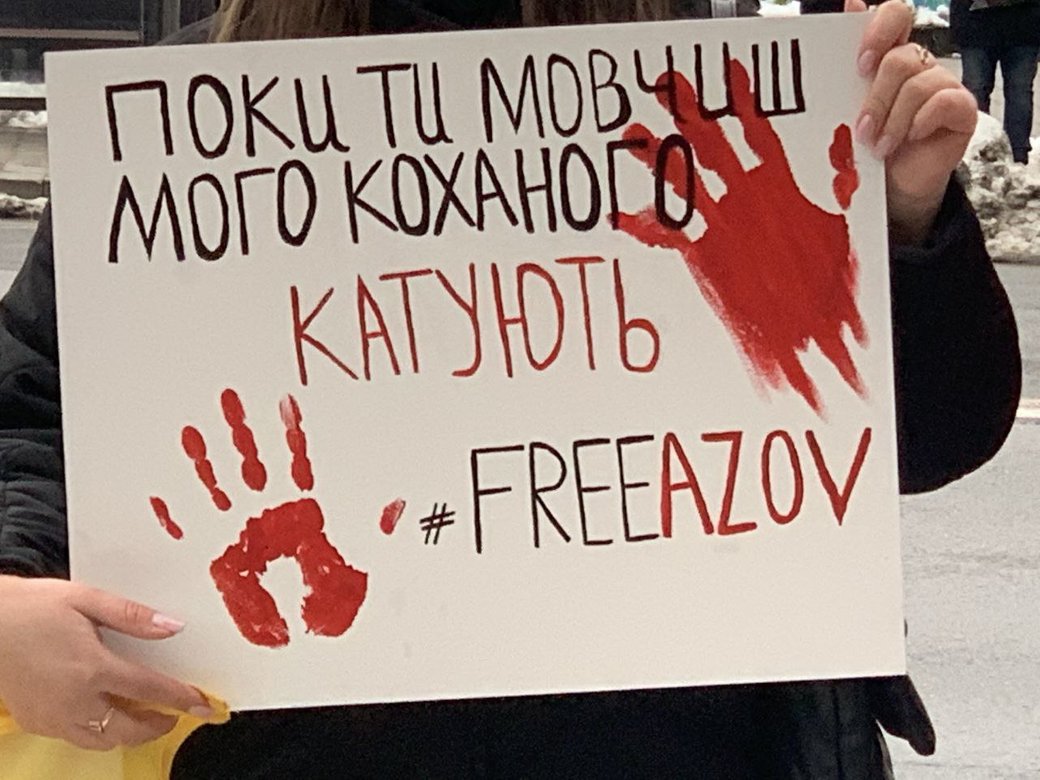
Ruslan Romanov has become the latest Ukrainian to die in unexplained circumstances in Russian captivity, with even the fact of his death only learned by chance. The news that yet another Ukrainian prisoner of war had not survived Russian imprisonment coincided with Russia’s formal withdrawal from the European Convention for the Prevention of Torture and abandonment of one of the last mechanisms for investigating reports of torture and ill-treatment in Russian prisons. Although those mechanisms have always been flouted in the case of Ukrainian POWs and civilian hostages, Russia’s withdrawal from the Convention is surely confirmation that its widespread use of torture, deprivation of food, medical care and other forms of ill-treatment are state policy.
Russia is increasingly concealing even the names of the Ukrainian prisoners of war whom it illegally puts on trial. Fortunately, Mediazona noticed that a ‘trial’ underway at the Southern District Military Court in Rostov had been terminated due to the death of the defendant and was able to learn that the deceased was Ruslan Romanovych Romanov, a Ukrainian prisoner of war. There is no information about his age, nor how long he had been in captivity. The charges against him, however, probably shed some light since Russia has orchestrated politically motivated rulings declaring the Azov Regiment, the Aidar Battalion and several other units of Ukraine’s Armed Forces ‘terrorist organizations’. Those rulings are then used as supposed justification for bringing absurd ‘terrorism’ charges against prisoners of war who were defending Ukraine as part of those units when taken prisoner. Romanov was accused of ‘involvement in a terrorist organization’ (Article 205.4 § 2 of Russia’s criminal code); ‘involvement in the activities of an organization declared terrorist on the territory of the Russian Federation’ (Article 205.5 § 2) and ‘training in terrorist activities’ (Article 205.3). The addition of Article 205.5 seems rather new and may well have been added to justify making the sentences even longer. All of these preposterous ‘trials’ against Ukrainian POWs for defending their country against an invader are in flagrant violation of the Geneva Convention Relative to the Treatment of Prisoners of War to which the Russian Federation remains a signatory.
The indictment had only been passed to the court in August 2026, to be heard by ‘judge’ Denis Vasilievich Stepanov. These are not real trials, as a guilty verdict is guaranteed, as is a monstrously long sentence. After the preliminary session, which is about procedural matters, there was a postponed hearing, seemingly one that did take place, on 22 September 2026, with the next, on 15 October, terminating proceedings due to the death of the accused man. It is not certain that Romanov attended the hearing on 22 September. During the first wave of Russian ‘trials’ of Ukrainian prisoners of war, the FSB or Investigative Committee invariably produced ‘videoed confessions’ almost certainly extracted through torture. It is not clear whether Russia is bothering with publicizing the ‘videoed confessions’ in these cases where the POWs’ ‘trials’ are based solely on the military unit to which the men belonged. Torture cannot, however, be excluded as the method of trying to force ‘confessions’ that are not retracted in court. Ruslan Romanov would not be the first Ukrainian to have died when the so-called ‘investigator’ or fellow torturers got ‘carried away’.
In reporting Russia’s official withdrawal on 1 November 2026, the Council of Europe noted that the Committee for the Prevention of Torture had received “numerous accounts of alleged acts of torture and ill-treatment in places of detention by Russian officials”, both on occupied territory and in Russia, but had been prevented from carrying out visits.
Russia’s obstruction of UN investigations into the downing by a Russian BUK missile of MH17 on 17 July 2014 and the killing of 50 Ukrainian prisoners of war in occupied Olenivka on 29 July 2022 were undoubtedly aimed at preventing official and damning reports. With respect to its treatment of Ukrainian POWs in Russian captivity, the methods cannot work as Russia has to release some of the prisoners of war in prisoner exchanges. These former prisoners’ testimony has led international, as well as Ukrainian, investigators to conclude that Russia is torturing 90 or even 95% of Ukrainian POWs. Almost five years after its full-scale invasion of Ukraine, Russia has still not opened an official camp for prisoners of war, with this in direct breach of the Geneva Convention. It is, instead, holding Ukrainian defenders in as many as 300 places of imprisonment without any access to international observers. That torture and ill-treatment of both prisoners of war and civilian hostages are part of Russian state policy was confirmed as early as September 2023 by Dr Alice Edwards, UN Special Rapporteur on Torture. She had spoken with many former prisoners of war and spoke of the recurring forms of torture listed, and of the apparently systematic nature of such treatment. The cases of torture, she was forced to conclude, were not isolated incidents but part of Russian state endorsed policy. This has since been reiterated on a number of occasions by the UN Independent International Commission of Inquiry on Ukraine. In November 2024, the Commission concluded that Russia is pursuing a coordinated state policy of torturing Ukrainian prisoners of war and civilian hostages with this constituting a crime against humanity.
It remains very difficult to find out about individual victims who did not survive the torture and ill-treatment. Russia delays providing any information at all. It took months before it handed over the body of 27-year-old journalist Victoria Roshchyna who is believed to have died from both horrific torture, and emaciation. and Dniprorudne Mayor Yevhen Matvieiev, who died from the torture he endured when brought to one of the Russian prisons. Even less is known about other deaths. In May 2026, Bohdan Okhrimenko, Head of Ukraine’s Coordination Headquarters on the Treatment of Prisoners of War, reported that Russia had returned the bodies of 375 Ukrainian prisoners of war or civilians who died in Russian captivity. Autopsies uncovered signs of torture, emaciation or indicators that they had been denied vital medical care. These were people whose captivity had either been confirmed by the International Committee of the Red Cross (in 145 cases), or from other sources, including from former prisoners who could confirm having seen the person alive in a Russian prison. The Memorial Support for Political Prisoners Project recently issued a report on 69 deaths in captivity of victims of repression since 2022, with this including Ukrainian political prisoners, such as Crimean Tatar civic activist Dzhemil Gafarov, Kostiantyn Shyrinh, two very young boys Danylo Dakhov and Pavlo Hrymak, Vasyl Stetsenko, Oleksandr Ishchenko, and others. Such a huge number is already bad, but it is by no means comprehensive. It is also worth drawing a distinction between those, like Kostiantyn Shyrinh, Oleksandr Markov and Victor Demchenko, who should not have been political prisoners, and whose medical needs were not met, and those, like Dzhemil Gafarov whose health issues meant he should never have been imprisoned at all. Russia is currently holding at least two Crimean Tatar political prisoners (Lenur Khalilov and Amet Suleimanov) whose illnesses mean that, even according to Russian legislation, they should not be imprisoned, yet they are, essentially, being left to lie, very likely, in Khalilov’s case, in terrible pain..In accordance with the Third Geneva Convention, Russia bears responsibility for the lives and health of those in its custody. The real scale of its violations remains unknown as it is continuing to reveal the whereabouts of so many civilian hostages seized from 2022.